Our brutal, hard-hitting, blow-the-lid-off-the-conspiracy coverage of the 2016 Road America Fall Vintage Festival continues today. As a reminder, when we last left our hero, Volvo was the "Marque of the Event". It wasn't exclusively Volvos at the fall fest, but there were lots of Volvos at the fall fest.
 |
| For those of our readers who are not Swedish, or a Volvo, Lingonberries are indigenous to Sweden. The owner seemed ready to do a few test laps, even without an exhaust cutout. This is possibly a benefit of the internal lingonberry combustion engine. |
 |
| A decal on the same Volvo. I'm sure the Italians find this "molto divertente". |
 |
| Turns out, Volvo corporate had a tent at the fall festival. This P1800 was in flawless, like-new condition. The tires even still had those rubber whiskers on them. |
 |
| Badges used to be much, much better. |

Outside the tent for a sheet metal forming company was this Ferrari 350 GTO, just sitting there. Naturally, I assumed it was a replica. However, upon showing this photo to an older gentleman with a substantial car collection of his own, he assured me it was real. How to tell? "It's too perfect to be a replica." he said. See those inset mini-lights under the headlights and below the yellow side marker lights? Apparently the body panels for the hood, if mass-produced using dies and presses, are too intricate to include in the form. Those light cups can only be formed into the hood by hand, and replicas tend to be produced by automated means. Note that the whole nose of the car is one
single piece of sheet metal continuous piece of welded aluminum (see note below). Off the top of his head, this elder statesman guessed the car to be worth about 2.5 million. It was just sitting there. No velvet ropes or anything. If I were an uncouth Visigoth, I could have waddled right up and literally breathed on it, like a filthy animal.
This makes me wonder. Assuming that, when you crash a car of this significance, you rebuild it with little regard to the cost (People do race them, believe it or not). How much of the car can be replaced / rebuilt before it's no longer technically "the original car" any more?
UPDATE: Alert Reader Steve sent some notes from his father regarding the construction of body panels like the nose on this Ferrari:
Clarification: The Ferrari front bonnet is actually hand welded together from smaller pieces using an oxy., acetylene argon gas torch. Not made of one continuous piece of aluminum as one might think because no seams are visible outside. Under the bonnet on unfinished surfaces seams should be visible.
Yes, absolutely and of course. I should have been clearer. The nose of that Ferrari couldn't have been formed form one single piece of aluminum. After Steve's email, I now recall seeing various TV shows showing builders welding together sections of aluminum, and then filing and smoothing away the seams. It's meticulous, highly skilled work, and, I think Steve will agree, is probably beyond the amount of work a replica car maker is willing to put in. This is why fiberglass is such a popular material for replicars to be made from.
Hat tip to Steve and his dad for waking me up! I'd be interested to hear what Steve's father has to say about whether or not the Ferrari in the photo is real or not. Here's what I think: Thing 1: It was on display outside the tent of a metal forming company. Thing 2: If it were a replica, it would very likely have a fiberglass body. Thing 3: It's probably real, as the body is probably aluminum, considering the setting. At the time, I lacked the temerity to go up and start knocking on the thing to listen for a clank or a thud. The very idea!
 |
| Uuuuuhhhh.... those side marker lights look pretty expertly crafted, in that, uuh, replica. So much for taking the old guy at his word. He also claimed to have invented the slot car, so, yyyeah. |
 |
A Lotus Super 7. This chassis is still used by a lot of kit car companies wanting
to make a light, agile track car with the room for a lot of different motors. At an
event like this, of course this one was an original. |
 |
| Badges used to be much much much better. |
 |
My first time seeing one of these! I had no idea what it was, and the badge's script was hard to read (TSO? T&O? Dunno). Having run back to GO! Tower and consulted The Ultranet, I now know this to be an Iso Grifo (where "Iso" is not an acronym, so, you just say it, instead of reciting the letters). It was built to compete against Ferrari's and Maserati's grand tourers.
That other badge at the top? That's a Bertone bade, indicating that this car's styling was done by Bertone, which was a design house that did nothing but tell car companies what their cars should look like. Bertone's involvement in your car's design was such that manufacturers would include a separate Bertone badge in addition to the marque's. The designer of the Iso Grifo was Bertone's legendary superstar Girogetto Giugiaro, whose resume includes such titles as "Car Designer of the Century" (not making that up!). It was nice of Bertone to make their badge such a distinctive shape, so that even the blind could thereby know that they should be weeping with inspired awe. |
 |
Prog rock dinosaurs Yes's 1974 magnum opus "Tales from Topographic Oceans" features the lyric "What happened... to this song... we once knew so well?" Lost wisdom and civilizational regret are a thematic undercurrent of the album. Looking at anything designed by Bertone will make you wonder what happened, indeed.
Side bar: It is the author's considered opinion that Tales from Topographic Oceans, when used as a soundtrack for playing No Man's Sky, can be appreciated without chemical motivation. Your mileage may vary. |
 |
| A Griffith TVR 200 - a tiny, fiberglass-bodied sports car sold in the United States as a Griffith Series 200 and in the UK as a TVR Griffith 200. It was powered by a 289 CI V8. Zero to sixty in 3.9 seconds, and in unrestricted race trim, it sounded unbelievable. |
 |
| Close to 300 horsepower, a very short wheelbase, and nearly unnoticeable curb weight makes these a bit of a handful at speed. |
 |
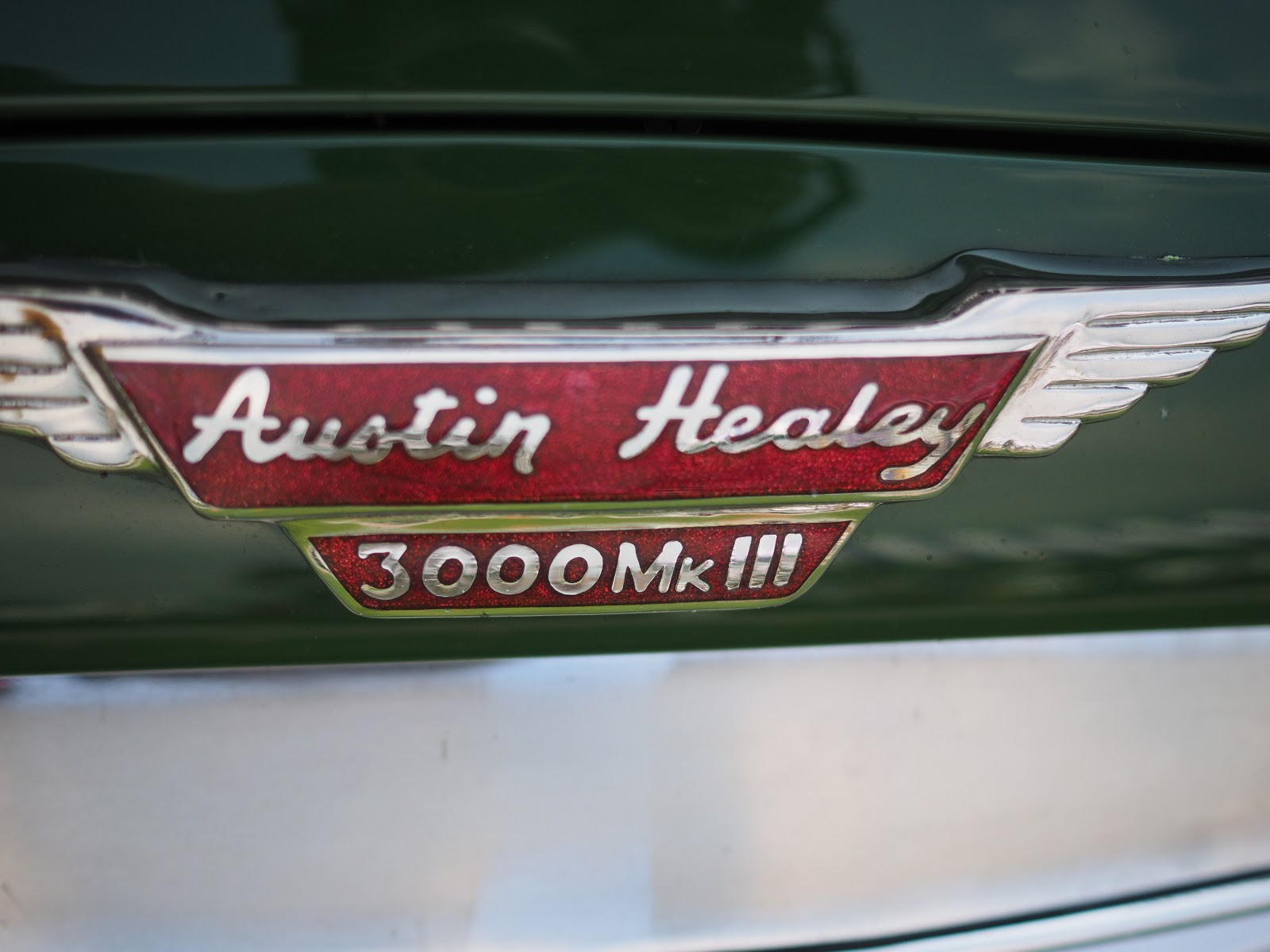
| An immaculate Austin-Healey 3000 Mk 3. It was in such perfect condition that it may have been there for show only. However... |
 |
| ...a GoPro camera mount is not "period correct", and wouldn't be there if the driver were not expecting to capture footage during a race. |
 |
| ...And, Sparcos were not a dealer option on the Austin-Healey, so yes, it was there to race. |
 |
| Can we please, please, PLEEEASE have good badges again? |










 Posts
Posts



