Showing posts with label computers. Show all posts

1/18/24

Wifi Dispenser

 Wifi dispenser. Are YOUR hands 5 GHz compatible, or just 2.4?


6/10/16

ENIAC

Joke #1 - "ENIAC, knock it off. I can feel that."

Joke #2 - Research entry - March 11th. 11:45AM. Still getting some weird harmonics from racks five and six. Maybe re-check connections after lunch. Hey! Today is taco Tuesday!

Joke #3 - The origin story for Spider-Man's real worst enemy, Doctor Rectupus.

Joke #4 - Logitech's skunk works boffins hard at work on their most compact input device 1946 had to offer. After initial success with "The Logitech Easy Input Monolith", it would be made slightly obsolete later in that same year with the release of a more popular wireless version.

Joke #5 was quickly submitted by Mr.FancyHyperlobicOmnicognateNeutronWranglerPants_42, (who clearly thinks he's so clever, he could talk all four legs off an Arcturan megadonkey, but only I could persuade it to go for a walk afterwards.) - Photo of the Milliard Gargantu-Brain at Maximegalon, which can count all the atoms in a star in a millisecond...


[Commenter jokes will be added to the post.   -Mgmt.]


11/6/15

Allied Electronics and the TRS-80 - More information revealed!

Those among you who have been with us from the beginning may recall our hard-hitting investigative report from three years ago, on the back cover of the 1977 Allied Electronics catalog, where we revealed the pricing info for Tandy's computing powerhouse. Well, this morning, someone flipped over that very same back cover and found even more pricing and specifications for the available system configurations for the TRS-80! Put your Mastercharge on lockdown, people. Spoiler alert: This could get expensive.


You could get the $599 Level-1 BASIC, which, despite being perfect for the computer novice, comes with the "professional keyboard". But if you're an ambitious power user, you'll need more RAM - like, 16K of it, muthafuckaaaaa!!! $899, please.

But what if you need to show proof of your l33t haxors skillz? You need to print out your exploits. that's why you probably want the fast 4K/Printer system for just $1198. It comes with a printer that will print a screen grab on 4" of paper, so you can show everyone in the chess club that horizontal line you made flash on and off.

No, wait. That one's a downgrade to 4K of RAM. Don't waste your time, man. Deliver a few more newspapers and score yourself the Level-II 16K/Printer/Disk system or be a loser. For $2385. You can do all your engineering and clinical laboratorying on it. Save whatever you program onto cassette and listen to it while you're fahr'n fahr'n fahr'n auf der autobahn to class in your Gremlin.

Wait, what's this? There are 32 K's? How is this possible? You need that many K's, plus a second mini-disk unit. No question. It doesn't matter if it's an additional fifteen hundred dollars. A war machine like that will pay for itself once you start organizing your recipes on it, or controlling your inventory. You even get a better printer. Whatever a "line printer" is.

Hey, wait a sec. Why does it have an "expansion interface"? How could you ever use more power than this? It must be for something else. Maybe a special port for the very interested power user.

Click for big.


5/5/15

NORDAC Electronic Digital Computer - Build your own Pee Cee!

Are you curious about the operations of The Computers? Would you like to discover the basic operations of million dollar commercial computers? NORDAC, mothafuckaaaa!


For only $64.95, or $504.81 in current Futurebucks, you can learn to work on the big rigs build a "personal computer" or "Pee Cee" that can perform fifty thousand operations per second! That's fifty thousand... with a B! Discover whether this wire will make the yellow bulb light up, or the slightly different yellow bulb light up. Then, you will have the power, and the woman, and possibly money, in a maybe different order. But mostly, you will have an illuminated bulb... or the other one.

Primodrial computers love to name themselves "(something)AC". ENIAC, EDVAC, EDSAC (yes, really), BINAC, AVIDAC, SEAC, SWAC, UNIVAC, etc. (Each sold separately). There's no mention in this ad what NORDAC stands for. Maybe it means:

-North American Defense And Cheese
-Numerical Operation Recombinant Arthropod Crumple zone.
-NOrman Rockwell Defense And C.H.U.D.
-Non-Obligatory Rogers Dandy And Crammerstien
-New Orthopedic Routine Doohickey And Computer
- Not Orville Redenbacher Deciduous Adjustible Corn
-Nash Oates REO Duran And Crosby

So what's at 372 Main Street in Watertown Massachusetts now? Let's have a look.


AHA!!! The Maranatha Christian Church! The faithful adherents of Maranathanism await the return of the mighty NORDAC, who will perform fifty thousand calculations and bring swift judgment against all who doubt The Bulb... or the other Bulb.


7/30/14

RCA - Computers! We have some!


Hey, you know how everything is better when it's designed on a computer? Well, that was once called "Computer Aided Design", or "CAD". Now, it's just called "designing something". See, now that everything except going to the bathroom is digital*, it doesn't really add anything to throw "computer" in front of it. This ad comes from 1970, which was a time before they had a name for designing something with a computer.


So, since they didn't have the acronym "CAD" to throw around and impress people, they wrote four paragraphs of copy to explain that computers are useful, because how would people know otherwise? They stop short of saying that there was any kind of computers actually inside their products, of course, because there weren't. Computers back then were still giant things that took up your whole darn computer lab. So where did they have their Nerf wars? That's what I want to know.


Wow. nice COM-PEW-TOR you've got there, RCA. I see you spent the extra cash for the blinkey lights panels. Good choice. Those definitely let people know they're looking at a computer and not just a prop. Assuming there ever was a computer manufactured that had a big panel of unlabeled multicolored light bulbs mounted above the tape drive, what did the bulbs represent? Maybe the machine ran on a thirty-two-Tinkerbell system? Another good choice there, because those had way better error correction than the old sixteen-Tinkerbell units.

People in 1970 did know one thing about computers: every computer used the font Amelia. See the goofy text that says "computer crafted color"? That's Ameila, and no computer in reality has ever displayed text in that font, unless somebody was being cheeky.

Now, though, I think we've finally let go of that inaccurate Amelia font myth. Now, we only use Ameila to be ironic, or, you know, cheeky about computers. Come to think of it, you know what other computer trope needs to die a fiery death? The fact that, in every movie, computers STILL make "bleepity bleep" noises when displaying text or calculating something. Nobody's computer has ever done that, and if it did, the owner would immediately march straight off to the CONTROL PANEL>SOUND menu to turn that shit right off. And yet, here in The Future, movie computers go bleepity bleep. Thanks, movie industry, for always talking down to your audience, eighty percent of which is probably smarter than you are.

*Unless you consider the fact that "digital" also can mean "of, involving, or relating to, the fingers", in which case going to the bathroom usually is a digital procedure.

Click for big.


5/21/12

Radio Shack TRS-80 - A "powerful", "expandable" "microcomputer".

 Aaah, the simple pleasure of laughing at computers of the past. Here's a wonderful page from Allied Electronics' (Yep! Still around.) catalog of 1977, the first year that Tandy's TRS-80 microcomputer was available. Who can resist the lure of a computer rendered as a woodcut in vivid black, white, and brown?
There it is, in all it's liney glory. The TRS-80 actually was pretty "micro" for the time. Remember that computers tended to be sofa-sized or larger back then. Read the impressive specs! Read them again because you're not used to seeing numbers that small! Then marvel at the bargain price of $600. For me, the most shocking number in the price breakdown is the monitor. $200 for a twelve inch monochrome CRT seems criminal to my spoiled eyes.

For those of you too young to recall, computers of this vintage stored their info on tape. For consumer units like the TRS-80, that meant cassettes. Yes, you'd put in a cassette and press "play" to run a program. This was cutting edge, people, believe it or not.

There's some nicely weird art in this ad. The Blandishment and Photoshop Squad has separated the dorky clip art guys and the TRS-80 "product shot" from the catalog for solo performances in whatever document, email, or ransom note you choose. Send your letters of gratitude to them here at GO! Tower. I'll be sure the recycle bin reads every word. get your rude fingers ready to right click some clunky computing onto your hard drive in three, two, one...

1000 px wide.
1000 px wide.

200 px wide.
 
200 px wide

Click for big microcomputer.


10/27/11

Superzapping in Computer Land - The ride of the "Dalton Gang".

This article comes to us from the January 12, 1981 issue of Time. (Actually, "TIME" always spells their name in all caps, so I guess they want you to shout it whenever you say it.) The article covers the antics of four thirteen-year-old boys and their proto-hacking adventure.
Since this is 1981, and most people only understand computers as crazy things that huge companies have, the author (Frederic Golden) takes on the task of teaching some new words to TIME's audience. This is always hilarious. It's unclear whether Golden himself had heard the new terms only recently, but it's easy to imagine him using quotation fingers around strange new words like "access"... hopefully just for the benefit of the readers.
New "jargon" taught to TIME's readers in this article:

"accessed"

"seized control"

"bits"

"garbage"

The four hackers in the article were all students at a New York private school called Dalton School, and they had hacked into Datapac's (an ISP) system. This, of course, was a softball opportunity for TIME to call them The Dalton Gang. I'm sure there were high fives all round the office at TIME when they thought that one up. Sadly, The P.A.G.  Research and Googling team was unable to find any updates about who the kids were or what they've been up to since then. Since they were only thirteen, their names weren't mentioned in the article and records of this crime are probably sealed or whatever. Incidentally, the amount of data the hackers destroyed: 10 million bits. That's 1.25 megabytes. It would fit on a floppy disk. That's adorable! Like a kid who had his lollipop stolen. Better still, that 1.25 Mb was one fifth of Datapac's computer's total storage capacity. So, a 1981 ISP's computer had 6.25 megs of storage. BAH hah hah, snort! Hang on. Let me go get some coffee so I can properly laugh it out my nose.

In '81, high-profile computer crime was still a curiosity. Back then,  Kevin Mitnick was just getting warmed up and even the FBI didn't know his name yet. Sure, it had been about ten years since John Draper had started his career by phone phreaking and by '81, he was already developing software for the Appe II. However, computer security was still a kooky sci-fi idea to most people. How kooky?
Jeez oh man. "Some" users are resorting to coding devices and "changing passwords". "What has the world come to?" they must have thought. I'm sure that, back in 1778 when the first tumbler lock was designed, people hung their heads in disappointment. What a sad day it must have been for people to realize that if you leave your front door closed with a nice heavy chair leaning against it, somebody might just find their way in and mosey out with your harpsichord under his arm.

I try to be in favor of any effort to remove money from dumb people. Still, the naivete of 1981 is maddening. That must be how most of the world looks from the perspective of guys like Anonymous.

The illustrations are by Kimble Mead. The name sounds familiar, like I should know who that is. 

A Google search page on the name is pretty much a bunch of art-related sites all stumbling over each other to proudly announce they've never heard of him. Nice work, Google. Here's a book he's illustrated on Amazon. Aah yes. That's him. Still beating the dead horse of bulbous, post-Yellow-Submarine Peter Maxism after all these years.

For further reading on early hacking, I recommend watching some TV. This wonderful documentary on Discovery Channel is... well, wonderful. Surprisingly, Discovery will let you watch the whole damn thing online via that link. It tells the story of Draper and Mitnick and pals with interviews and not-too-annoying reenactments. It also tells the story of the blind kid in the 60s who could whistle the control tones into his telephone to "seize control" (heh) of the phone system. Careful though, Discovery may try to sell you a DVD or something. I carry this doc around in my phone because I love it so much. I watch it a few times a year, because it's interesting to see how things get started.


Maaaaybe somewhere in the future, someone is reading this very post on an archived compilation of the entire internet stored on a 75,000,000 petabyte nano-USB stick while they're riding the hoverbus to their job at the space cafe? I wonder what we're starting...  right... now? WooooooooooOOOOOooooo!


11/18/10

Honeywell Automation - Nice nerds!

Hey, nice nerds! Where'd you get them? 1966. Sure everyone in '66 looked like a nerd if they wore glasses, but the fact that these people are basically sitting IN a computer with the equivalent horsepower of a modern clock radio means they were on the cutting edge of computing for the time. Dig that keyboard with the round keys. I wish someone would make modern USB keyboards that looks like ancient keyboard of old. The closest you can come is an old IBM Model M keyboard from these guys. Yep. I've got one, and it's brilliant. But you can't do any typing after lights out because the noise will wake the neighbors. Practice the drums instead.
Anyway. Nerd jokes!

Joke #1 - "...and right here, the system has calculated the number one reason you're a virgin. This will be great. Hang on, let me get the P.A. microphone."

Joke #2 - "I know all the 'cool' kids signed up for my brother Alan's course, but I think we'll have plenty of fun, too. I'm professor Charlie Parsons, and welcome to my project."

Joke #3 - "See kids? Using our new computer lab, we've 'digitally encoded' the first three seconds of a Herman's Hermits song. Now all you have to do is go invent a dial-up modem and you can 'download' it in only four days."

Joke #4 -"Umm.... ten"

Joke #5 - "Hmm. Nope, Kent. Says right here that there's no way in hell she'll go to homecoming with you. That could have been embarrassing, huh?"

Joke #6 - "Hey, wow! You're pregnant! ...You can stop smiling now."

Joke #7 - "... aaaaand the answer is 'beep'."

Joke #8 - "... now just sign here, and bingo! You've both un-friended each other."

Joke #9 - "... and there's your recipe, stored safely. There. Wasn't that a fun afternoon?"

Joke #10 courtesy of Craig. Hat tip to you, sir! - "...and if you'll look at the printout on Line 2320, Dexter, you'll note that you've scored 'Flopsweat' on the ENIAC Love Meter, the most powerful Love Meter known to man."

11/1/10

Vic-20 - Believe your eyes.

Poor, poor computers. Due to the basic reality of Moore's law, the laughability of old computers progresses in direct proportion to the power of new ones. As much of a superstar the newest, powerfulest machine is right now, it'll be the butt of jokes in, say, twenty years or so, when someone comes across advertisements proclaiming it's power.

Those CAN'T be actual Vic-20 screens, you lying bastard! The graphics are hyper-real! Actually, they're not too bad for 1983, considering that your TV's remote probably has more computing power than a Vic-20.

Click the image to enlarge, and anyone over the age of twenty should be able to name the games being ripped off here. From left to right, they look like Galaga, Defender, Something with squares in it, and Donkey Kong Junior.

The airbrushed eyeballs at the top are pretty terrible. Remember how everyone in the eighties was convinced that airbrush was the ultimate medium? Here's an example of a bright-eyed young artist trying his hand at sprayed art. Ug. Shading human skin requires a lot of different colors delicately balanced. Lots of finesse. This guy painted some salmon orange color and shaded with brown. See the highlight on the right side of the nose there? Never spray white directly onto your base tone. You need to go through a yellowish color before you get to white or the white will look chalky and blue. Ah well, video games were a small industry back then, and Sierra probably didn't pay much.

Sierra On-Line is remembered with a moist eye by many computer game old-timers. They were a husband and wife team who made some of the greatest graphical adventure games like King's Quest. They took the classic text-based adventure game format (like Zork) and added graphics. Since text-based games made your imagination work to create the pictures, adding graphics to stories of similar quality was a big leap in immersion. Compared to pure text, graphics of any kind were mind-blowing. Sierra never leaned too heavily on graphics. They (almost) always emphasized compelling story telling.

So what's with these arcade game knock-offs? I think the popularity of games like Donkey Kong and Defender -  and the sweet sweet cash they earned -  were too tempting to ignore.

5/14/10

Neurotic Computer - You should be so lucky.

In the May 1957 issue of Popular Electronics, there ran this short news announcement about British researchers trying to build an "electronic brain" that was "neurotic".

Why all the quotes? Because neither of those terms is widely used anymore. "Electronic brain" has become obsolete ever since computer programming became separate from the hardware. In '57, building a computer program meant connecting wires and transistors. This was very much like a human brain, in which the software and hardware were kind of inseparable. Now, as you know, software is just code and you run it through pretty much  whatever machine you want.

As for "neurotic", psychological understanding has become more thorough, identifying specific disorders. "Neurosis" is not really scientifically useful as it's so general as to be almost dismissive.

 Computer scientists have been assuming they're on the verge of creating an artificial human brain for about fifty years. In 1957, they were apparently so worried about creating an artificial brain that would turn out to be crazy that they were trying to figure out how to deal with a crazy computer. That seems a little overly optimistic, considering the computing power available at the time. Why teach a program to become overconfident and sloppy? I guess they were afraid of finding themselves with a crazy program on their hands and not knowing how to  "heal" it. This shows us how little they understood the difference between a machine and a human.

For the experiment described in the article, the "brain" was quizzed by another computer, and it's performance led it to become overconfident at times, which led to sloppiness and panic, but only because they told it to. The scientists would then have to come to the rescue and soothe the computer, because they told it to enjoy that. Hoo-ray.

So where are we now? For an artificial intelligence progress report, you could do worse than to ask Hans Moravec, a faculty member at Carnegie Mellon University specializing in robotics and AI. Based on the exponential growth of computer technology, Moravec's current prediction is that by 2050 we'll have a machine that can mimic a human mind.

Unlike the goofballs in 1957, Moravec has the presence of mind to point out that we don't need artificial human  minds. We have those already. However, the milestone is hard to ignore. The ironic benefit will be that once we can simulate a human brain, the machine will be more useful than a human brain for solving complex problems, because frailties like confusion and fatigue will have to be intentionally engineered into the program in order to mimic a human. In their "natural state", AIs at that point will be more reliable and linear than our squishy bags of goo.

At that time, I look forward to downloading my mind into a robot so I can leave this rapidly decaying pot roast behind and cruise around on my tank treads, dispensing wisdom and charged particle beams to my fellow man. Imagine the new excuses and social escape routes that could be mine. If I were in a tough spot and didn't want to talk to somebody, I could just throw an error message: "This application has encountered an error, and must be shut down" and I'd go into sleep mode until the other person gets bored and goes away. With my luck, crashes and bugs will be a thing of the past just as soon as I become a robot, thanks to the relentless improvement of technology.

4/2/10

Dr. Ed Roberts - Altair's dead daddy.

Today Dr Ed Roberts died of pneumonia at the age of 68. He invented the Altair computer. The whaa? The Altair. It's the computer that began the PC revolution, and the progenitor of the thing on your desk or in your pocket.

In 1975, huge tech companies or universities had computers. They filled a room and you had to book time to get to use one. Every nerd dreamed of having one on his desk, to mess around with. Then Dr Ed Roberts designed and sold the Altair as a kit, but it was available as a complete unit for a bit extra. It had no keyboard or monitor. It was a box with switches and lights. In the picture to the left, he's posing with a terminal, which was added later, to make it easier to work with the machine. Imagine programming your computer by flipping a row of switches on the front, and reading the output only through a row of red lights. Crazy.

But at the time, it was the only computer you could buy for less than a zillion dollars. Here's a YouTube video explaining the Altair's importance better than I can. Members of the Home Brew Computer Club (of which Bill Gates and Steve Wozniak were members) went crazy over it, simply because it was a computer they could mess with. The big achievement for the club was when one member found that the Altair would produce FM noise from it's circuits, and by placing a radio next to it, you could hear this noise as a pitch. Before long, they had the Altair playing "Daisy" over the radio. The club went apeshit.

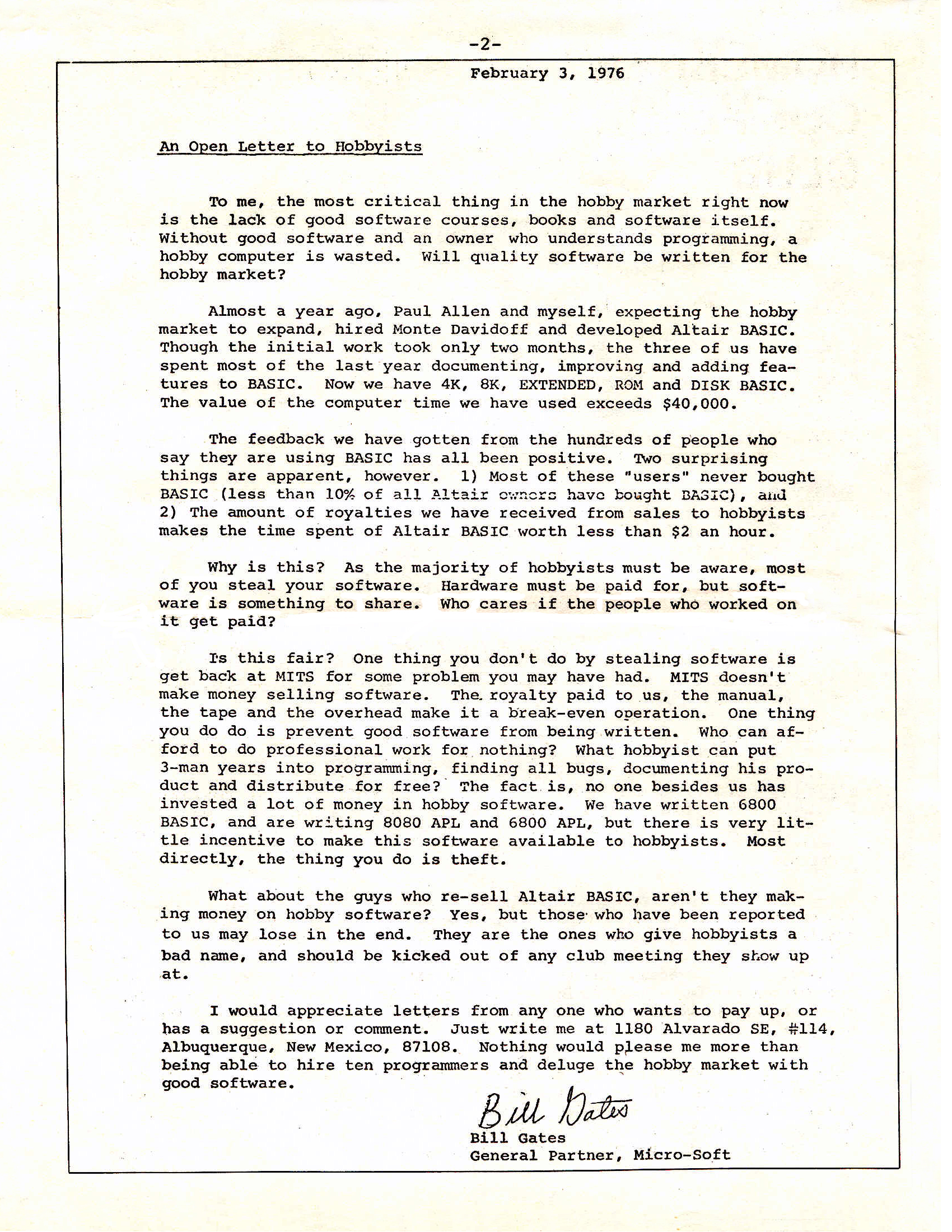
Another interesting part of the Homebrew Computer Club's history is Bill Gates' open letter to the club, stating that using a programming language without paying for it is wrong. It's fascinating to see that, even in the early seventies, the future giants of the tech industry were showing their colors. Gates the litigious entrepreneur and Steve Wozniak the open source tinkerer.

So, although the Altair bears about as much resemblance to your laptop as a penny farthing does to a Lamborghini Gallardo, it was the daddy of them all, and it's daddy died today. Don't cry into your keyboard. It's bad for it.

Triumph of the Nerds is a three part documentary that tells the whole story of the computer industry's beginnings. It's available on YouTube, and it's really good. Each one hour episode divided into six parts each.

Or you can buy the DVD if you're not into open source sharing.