

Showing posts with label safety. Show all posts
Showing posts with label safety. Show all posts


2/7/17
Bike Boners Kill
This critical safety alert was sent in by Alert Reader Dave Pryor, who cautions all of us on proper boner management. Don't become a statistic. My road bike is about thirteen years old now, and I'm starting to look at new models. They sure are pretty. It's always a challenge not to have a total bike boner and overspend on a gorgeous new bike.
Those of us who are less than one hundred years old may need reminding that, at one time, "boner" was an innocent word. If you decide to click on the Dictionary dot com link there, be sure to click the little speaker to make the Dictionary dot com pronunciation robot say "boner". You can practically hear her eyebrows waggle, the way she says it. Naughty girl...
http://www.dictionary.com/browse/boner?s=t
boner2
noun
1.
a foolish and obvious blunder; stupid mistake.
Origin
1910-15, Americanism; bone(head) + -er1
Dictionary.com Unabridged
Based on the Random House Dictionary, © Random House, Inc. 2017.
So, a "boner" is a mistake made by a boneheaded person. That said, try to choose the right time and place to show your bike how much you care. Definitely not the middle of the street. And for chrissakes, watch out for the sprocket, man.

1.
a foolish and obvious blunder; stupid mistake.
Origin
1910-15, Americanism; bone(head) + -er1
Dictionary.com Unabridged
Based on the Random House Dictionary, © Random House, Inc. 2017.
So, a "boner" is a mistake made by a boneheaded person. That said, try to choose the right time and place to show your bike how much you care. Definitely not the middle of the street. And for chrissakes, watch out for the sprocket, man.
8/31/16
Watch your feet, The Dutch! You can't spot heal a foot.
Great. I had several German jokes lined up to go with this poster, like the one about commemorating the German invasion of Poland on Sept. 1st, 1939 (So long ago already? They grow so fast!). Turns out that text on the poster is Dutch, not German. It takes a big man to admit when he's wrong, and I'm gigantic, and an idiot.
And guess what? This Photochop didn't require anyone in GO! Tower to lift a finger! It was sent in by Alert reader Sandy! She done it her own self! How bout them Dutch apple strudels?


Be careful where you leave your naily boards and chocolate bars (apparently), kids. You might need to put your finger in your foot-dyke, stemming the spray of foot-juice.
Thanks for the free post, Sandy! Nice job rubbing out the original text. Making blank space is always the most important and least-fun part of making a Photochop. It's tedious, thankless work... except when someone thanks you for it... which they never will.
 Did you use Photoshop's "spot healing brush" for any of your text deletion work here? If you haven't tried it, definitely give it a go. It could be a real time saver for deleting letters and other blemishes.
It does it's best to figure out what you're trying to remove, and then remove it. When it works, it's nearly magical. When it doesn't -which is about half the time - the results are comical. Good news is, even when it screws up, you don't need to undo. You can just try it again on the spot it already ruined. You can do this again and again until it gets it right... or until you just reach for the clone stamp tool and do it yourself.
You can use either the clone stamp or the spot healing brush to erase the drops of blood you leave on the floor when you step on a nail because you can't read Dutch, partially because you think it's German, which you also can't read.
And guess what? This Photochop didn't require anyone in GO! Tower to lift a finger! It was sent in by Alert reader Sandy! She done it her own self! How bout them Dutch apple strudels?


Be careful where you leave your naily boards and chocolate bars (apparently), kids. You might need to put your finger in your foot-dyke, stemming the spray of foot-juice.
Thanks for the free post, Sandy! Nice job rubbing out the original text. Making blank space is always the most important and least-fun part of making a Photochop. It's tedious, thankless work... except when someone thanks you for it... which they never will.
It does it's best to figure out what you're trying to remove, and then remove it. When it works, it's nearly magical. When it doesn't -which is about half the time - the results are comical. Good news is, even when it screws up, you don't need to undo. You can just try it again on the spot it already ruined. You can do this again and again until it gets it right... or until you just reach for the clone stamp tool and do it yourself.
12/3/13
Child Seatbelt - Be safe in '67!
This totally safe and non-improvable child seatbelt was a great leap ahead, back in 1967. It was better than, say, just carrying your kid around lying on the dash, for example. Also notice that the extra-high child seat gives your special little one a clear shot at the windshield for that super clean "nothing but net" exit from the vehicle in the event of a crash.


9/20/13
National Board of Fire Underwriters - What the FFFUUUUUUUUUUUUUUUUUU.......
.......UUUUUUUUUUUUUUUUUUUUUCCCKKKKKK??????????


 |
| "Okay, class who feels neurologically impaired? Timmy, if you're not sure, you can just put your hand down." |
UPDATE: Due to massive reader response and threats, here is the adorable firey cowboy from today's ad. Right-click these little horsemen onto your hard drive apocalypse in three, two, one, RIGHTCLICKNOW!
 |
| 1000px |
 |
| 400px |
10/22/12
1936 "Turret Top" body by Fisher - Turrets syndrome.
Hey moderns! Are you ready to learn about automotive construction techniques of sixty years ago? No??? Fantastic! Then read on!
 The term "modern" just means "current". So, in whatever context you find the word, it's probably going to be hilarious if it's more than a few weeks old, especially when used to describe anything even vaguely technological. For some reason, this Body by Fisher ad opens by describing two kids as "moderns". I don't think I've ever heard anybody talk like that in a non-ironic way. Advertising from the Thirties is crammed to the rafters with ridiculous talk like this.
So WTF is "Turret Top"? Well, it's a registered marketing name, so of course it has little to do with reality. It's Fisher's attempt to get you to associate their cars with safety and defense, even though a turret is either a cylindrical architectural feature or a rotating gun installation. "What's that have to do with the roof of a car?" you ask? Nothing! Whee!
Basically, the shape of the sheet metal forming the roof of GM cars was slightly convex (domed) for rigidity. Back in the Thirties, this mattered because the skin of the car was far more structural than today. The sheet metal forming the Modern (heh) cars are basically an intricate labyrinth of sheet metal with a very thin cosmetic set of body panels laid over it. Back in '36, what you saw on the outside was much closer to "what you get", in that the car was simpler in construction without the structure of the car and the appearance of the car being divided between two sets of sheet metal.
Actual numbers are hard to find, but it seems that, back when this ad first ran, sheet metal on the outside of cars was about 18 gauge (1.2 millimeters thick), while current cars use something like 22 gauge (0.68 millimeters thick). This makes sense, because in the old cars, that sheet metal was doing more to hold the car's shape, whereas today it's mostly not. The car is pretty much just as rigid without the body panels as it is with them, thanks to the unibody.
Pathetically, Volkswagen tried to use the same argument to tout the strength of the New Beetle in the early 2000's. The "Round for a Reason" campaign made a comparison between the New Beetle and the arched structure of the Roman aqueduct. This is bullshit. The car was round to make it cute, appealing to retro-minded people. It had nothing to do with strength. The current state of car design can produce a safe, rigid car that meets or exceeds all safety requirements regardless of whether it's round or square or whatever. The New Beetle was one of the worst cars of the time. It didn't have a reputation for being more or less structurally flimsy that other cars, but mechanically the New Beetle was junk.
So does all this mean your modern (heh) car is less safe than the 1936 ford? Absolutely not. Crumple zones, antilock brakes, and airbags make your car far safer than the Turret Top. Back then, cars were designed to be a stiff as possible in a crash. So when you hit something, the car stopped immediately, and your soft gooey body smashed into the steering wheel, dash, and windshield, releasing it's various goos and fluids all over the car's interior... if you're lucky. It's just as likely that the passenger compartment would fold up around you. Car designers did their best to make the car survive, but they had no clue how to keep the passengers alive.
As early as 1955, American cars offered two-point lap belts as an option, giving buyers the choice of being folded in half before being compressed longitudinally. This had the end result of folding you into quarters upon impact. This allowed the use of much smaller burial plots, and eased cemetery overcrowding substantially.
Here's that great crash test between a 1959 Malibu and a 2009 Chevy Malibu. It shows you everything you need to know.
Lastly, it's kind of funny that you can see the obvious shadow of the photographer, complete with fedora, on the little girl. Is this intentional or was it an unavoidable reality? No no. Of course there had to be a shadow. I mean did he have to wear a hat? Of course. It was 1936.

So WTF is "Turret Top"? Well, it's a registered marketing name, so of course it has little to do with reality. It's Fisher's attempt to get you to associate their cars with safety and defense, even though a turret is either a cylindrical architectural feature or a rotating gun installation. "What's that have to do with the roof of a car?" you ask? Nothing! Whee!
Basically, the shape of the sheet metal forming the roof of GM cars was slightly convex (domed) for rigidity. Back in the Thirties, this mattered because the skin of the car was far more structural than today. The sheet metal forming the Modern (heh) cars are basically an intricate labyrinth of sheet metal with a very thin cosmetic set of body panels laid over it. Back in '36, what you saw on the outside was much closer to "what you get", in that the car was simpler in construction without the structure of the car and the appearance of the car being divided between two sets of sheet metal.
Actual numbers are hard to find, but it seems that, back when this ad first ran, sheet metal on the outside of cars was about 18 gauge (1.2 millimeters thick), while current cars use something like 22 gauge (0.68 millimeters thick). This makes sense, because in the old cars, that sheet metal was doing more to hold the car's shape, whereas today it's mostly not. The car is pretty much just as rigid without the body panels as it is with them, thanks to the unibody.
Pathetically, Volkswagen tried to use the same argument to tout the strength of the New Beetle in the early 2000's. The "Round for a Reason" campaign made a comparison between the New Beetle and the arched structure of the Roman aqueduct. This is bullshit. The car was round to make it cute, appealing to retro-minded people. It had nothing to do with strength. The current state of car design can produce a safe, rigid car that meets or exceeds all safety requirements regardless of whether it's round or square or whatever. The New Beetle was one of the worst cars of the time. It didn't have a reputation for being more or less structurally flimsy that other cars, but mechanically the New Beetle was junk.
So does all this mean your modern (heh) car is less safe than the 1936 ford? Absolutely not. Crumple zones, antilock brakes, and airbags make your car far safer than the Turret Top. Back then, cars were designed to be a stiff as possible in a crash. So when you hit something, the car stopped immediately, and your soft gooey body smashed into the steering wheel, dash, and windshield, releasing it's various goos and fluids all over the car's interior... if you're lucky. It's just as likely that the passenger compartment would fold up around you. Car designers did their best to make the car survive, but they had no clue how to keep the passengers alive.
As early as 1955, American cars offered two-point lap belts as an option, giving buyers the choice of being folded in half before being compressed longitudinally. This had the end result of folding you into quarters upon impact. This allowed the use of much smaller burial plots, and eased cemetery overcrowding substantially.
Here's that great crash test between a 1959 Malibu and a 2009 Chevy Malibu. It shows you everything you need to know.
Lastly, it's kind of funny that you can see the obvious shadow of the photographer, complete with fedora, on the little girl. Is this intentional or was it an unavoidable reality? No no. Of course there had to be a shadow. I mean did he have to wear a hat? Of course. It was 1936.
 |
| Click for big. |
9/26/12
Telescoping Steering Wheel - Been there, did that.
I was pretty impressed that this farmer type of guy invented himself a telescoping steering wheel, as shown in this 1956 issue of Popular Mechanics. A quick glance at a probably-more-or-less-accurate Wikipedia page showed that Ford had this exact feature on Thunderbirds since the previous year, Ah well. Mister Greenjeans here still built himself one, so he still gets some credit, just not for getting there first.
 Turns out his name isn't Greenjeans. It's Jarsley Dvorak, which is way more interesting! "Jarsley"? Wow!
I'm no auto-collisionist, but I'm not convinced that having the passenger hit the steering wheel ten inches and thirty milliseconds later is a life-saver, but it couldn't hurt. The real face-saver would come in later years with airbag technology. Way back in '56, they hadn't even begun designing steering wheels to be easy on the skull in the event of a "whoopsie", so having the thing slide down a little ways was probably some help.
Pity that steering wheels can either be padded or look really cool. There were some really nice steering wheels back in the days before people knew you could hurt yourself by having one lodged in your sinuses. Old Jarsley was in on the ground floor of that concept. The top picture shows us how the conventional steering column fits nicely inside the head and chest. This is good, because three-point seat belts with a shoulder restraint weren't really available in the U.S. until 1968. As usual, the Europeans were a little ahead of us on that. Jarsley does look a little Swedish, doesn't he?

I'm no auto-collisionist, but I'm not convinced that having the passenger hit the steering wheel ten inches and thirty milliseconds later is a life-saver, but it couldn't hurt. The real face-saver would come in later years with airbag technology. Way back in '56, they hadn't even begun designing steering wheels to be easy on the skull in the event of a "whoopsie", so having the thing slide down a little ways was probably some help.
Pity that steering wheels can either be padded or look really cool. There were some really nice steering wheels back in the days before people knew you could hurt yourself by having one lodged in your sinuses. Old Jarsley was in on the ground floor of that concept. The top picture shows us how the conventional steering column fits nicely inside the head and chest. This is good, because three-point seat belts with a shoulder restraint weren't really available in the U.S. until 1968. As usual, the Europeans were a little ahead of us on that. Jarsley does look a little Swedish, doesn't he?
7/24/12
House of Hazards

Joke #2 - "Well, Mr. Hazards, I think you may want to consider changing the name of your hotel before you break ground."
Joke #3 - "Now, the full size House of Hazards will have real smoke, instead of cotton fluff, heh heh, but all the other details are accurate. If you and your wife approve the design, we can start building immediately and your family can move in as early as January. Sound good?"
Joke #4 - "Ah, there's your problem, see. Looks like your dolly was smoking in bed. I recommend you evict her immediately and replace her with a nice safe Evel Knievel action figure. Hmm... He does have drinking problem, though..."
Joke #5 - Ironically, the shoddy wiring in the Milwaukee Fire Department House of Hazards teaching aid burnt the structure to the ground mere hours before it's debut at the Safety Fair. Subsequently, an even smaller model of the model was built, to help demonstrate how future models of houses could be made safer.
Joke #6 - "See, Mr. Mayor? If only real houses were three feet high, had no walls, and were inside our fire department, we could virtually eliminate all fire-related property loss."
Joke #7 - "This switch turns on the orange lights, to simulate the fire, and this one here make the little people scream for help and jump out the window. This weekend, Bill will be wiring up our Domestic Abuse sound effects. We told him we didn't need it, but he really seems to be into it, for some reason."
[Commenter jokes will be added to the post. -Mgmt.]
 |
| Click for big. |

2/13/12
Chrysler Air Conditioning 1954 - Feels like a fridge. Looks like a fridge.
Recently, Jalopnik's informal daily reader survey, the "Question Of The Day" asked "What car colors need to make a comeback?" My response didn't make it into the top ten responses, but I am now surprised that turquoise didn't make it in either. I mean, paired with the white accents in this '54 Chrysler, it looks damn good. The effect is more impressive with all the shiny metal surfaces on the interior of the car.
See? Pretty. Could I live with it every day? Probably not, but just because I wouldn't buy a car this color doesn't mean I couldn't appreciate there being cars like this around. Car colors are stuck in a rut. Silver, champagne, black, white, with an occasional daring splash of dark blue or burgundy. There are exceptions to this chromatic vehicular dirge, but overall, the scenery on my daily commute is far too monotonous. I'm not helping, either. My car? Silver. Yawn. It was the one on the lot with the features I wanted, though.
Apart from the color of this Chrysler, the predominance of body-color surfaces inside the car is notable, as is the preponderance of hard metal surfaces, each of which are all too eager to bash your brains out. This was 1954, when building a safe car meant making a nice rigid box for you to bounce around in when you hit something good and solid. That steering column is a gorgeous piece of industrial design that will look just as pretty rammed through your chest. Fortunately, this will never happen, because the steering wheel will prevent it from sinking in too far, like the "basket" on the end of a ski pole. The woman in the ad will have to settle for admiring the beauty of the steering column with her head stuck through the wheel. Let's not talk about her daughter.
How safe was this car? The ad doesn't tell us which of their cars was used for the picture, and I'm not enough of a vintage car buff to tell just by looking at the interior (although I think there may be some in the peanut gallery that can). In general, a modern car weighs roughly the same now as an equivalent model did way back in '54, thanks to heavy stuff like electronics and safety equipment. However, they're structured VERY differently. Your average Car of the Future is designed to crumple itself into a ball to dissipate a crash's energy, sacrificing itself to save your life. They didn't understand much about safety features in 1954.
The National Highway Traffic Safety Administration (NHTSA) rates vehicular fatalities on a number of scales, but a key number to look at is the number of deaths per hundred million miles traveled in cars by the population. This is the "fatalities per VMT" (Vehicular Miles Traveled). This is clever, because it controls for the greater number of cars on the road these days, which would otherwise make it hard to compare numbers.
So, how many people died per hundred million miles driven in 1954? Six.
How many deaths per VMT in 2009? One and a half.
Also, current cars have more "soft touch" surfaces inside, like rubberized plastic, foam, and fabric. This makes the interior more quiet and less echoey. A conversation in the '54 Chrysler would have been like talking in an oil barrel. However, one thing all those shiny metal surfaces have going for them is that it's really easy to clean them. Viscera wipes right off.

See? Pretty. Could I live with it every day? Probably not, but just because I wouldn't buy a car this color doesn't mean I couldn't appreciate there being cars like this around. Car colors are stuck in a rut. Silver, champagne, black, white, with an occasional daring splash of dark blue or burgundy. There are exceptions to this chromatic vehicular dirge, but overall, the scenery on my daily commute is far too monotonous. I'm not helping, either. My car? Silver. Yawn. It was the one on the lot with the features I wanted, though.
Apart from the color of this Chrysler, the predominance of body-color surfaces inside the car is notable, as is the preponderance of hard metal surfaces, each of which are all too eager to bash your brains out. This was 1954, when building a safe car meant making a nice rigid box for you to bounce around in when you hit something good and solid. That steering column is a gorgeous piece of industrial design that will look just as pretty rammed through your chest. Fortunately, this will never happen, because the steering wheel will prevent it from sinking in too far, like the "basket" on the end of a ski pole. The woman in the ad will have to settle for admiring the beauty of the steering column with her head stuck through the wheel. Let's not talk about her daughter.
How safe was this car? The ad doesn't tell us which of their cars was used for the picture, and I'm not enough of a vintage car buff to tell just by looking at the interior (although I think there may be some in the peanut gallery that can). In general, a modern car weighs roughly the same now as an equivalent model did way back in '54, thanks to heavy stuff like electronics and safety equipment. However, they're structured VERY differently. Your average Car of the Future is designed to crumple itself into a ball to dissipate a crash's energy, sacrificing itself to save your life. They didn't understand much about safety features in 1954.
The National Highway Traffic Safety Administration (NHTSA) rates vehicular fatalities on a number of scales, but a key number to look at is the number of deaths per hundred million miles traveled in cars by the population. This is the "fatalities per VMT" (Vehicular Miles Traveled). This is clever, because it controls for the greater number of cars on the road these days, which would otherwise make it hard to compare numbers.
So, how many people died per hundred million miles driven in 1954? Six.
How many deaths per VMT in 2009? One and a half.
Also, current cars have more "soft touch" surfaces inside, like rubberized plastic, foam, and fabric. This makes the interior more quiet and less echoey. A conversation in the '54 Chrysler would have been like talking in an oil barrel. However, one thing all those shiny metal surfaces have going for them is that it's really easy to clean them. Viscera wipes right off.
 |
| Click for biggerness. |
9/28/10
Celotex - Keeps Steve Allen quiet
When we last left Steve Allen, he was promoting Wurlitzer electric pianos. He won some grudging respect despite the fact that he seemed a little prissy and a lot nerdy. Now he wants us to buy Celotex ceiling tiles in 1958, and he's selling them by showing us his super fantastic pad. Goddamn you, Steve.
 There's Steve with one hand on the piano... and one elbow. Steve recorded so many albums that he probably sounded pretty great right as the picture was taken. Maybe he's inventing a new chord that can only be played by one hand, one elbow and Jayne Meadows' thigh?
So, Steve had a huge career, wrote a ton of books, got to sleep with Jayne every night AND had a house this cool, all while looking like the kid that ate paste in first grade. Hat tip to you, Mr Allen.
 I'm getting pretty curious about this guy. I know he did a bunch of songs for Eyde Gorme and other famous sixties-type entertainers, but I couldn't hum one if you threatened me with violence. Maybe I need to fix that with the help of Amazon or iTunes? I have some homework tonight.
Anyway, there's Steve's house. Giant beams, stone floors, really cool room divider thing, very mod coffee table floor-to-ceiling windows, and ceiling tiles made of wadded paper (we hope). Do a Wikipedia search on Celotex and, rather than finding an article on the company itself, you find lots and lots of court cases, some of which are related to our old friend asbestos. Uh-oh spaghetti-o's!
I couldn't easily find any evidence that the Hush-Tone tiles in this ad were made with asbestos, and Steve lived to a pretty ripe old age of 78. So, assuming this ad was honest in that Celotex tiles were used in the Allen home, it doesn't look like asbestos took him out.
And even if he had died of mesothelioma, he'd just write a song about it and make a bunch of money. Steve was just that good, apparently.


So, Steve had a huge career, wrote a ton of books, got to sleep with Jayne every night AND had a house this cool, all while looking like the kid that ate paste in first grade. Hat tip to you, Mr Allen.

Anyway, there's Steve's house. Giant beams, stone floors, really cool room divider thing, very mod coffee table floor-to-ceiling windows, and ceiling tiles made of wadded paper (we hope). Do a Wikipedia search on Celotex and, rather than finding an article on the company itself, you find lots and lots of court cases, some of which are related to our old friend asbestos. Uh-oh spaghetti-o's!
I couldn't easily find any evidence that the Hush-Tone tiles in this ad were made with asbestos, and Steve lived to a pretty ripe old age of 78. So, assuming this ad was honest in that Celotex tiles were used in the Allen home, it doesn't look like asbestos took him out.
And even if he had died of mesothelioma, he'd just write a song about it and make a bunch of money. Steve was just that good, apparently.

7/27/10
Eagle White Lead - Paint so bright, you'll die.
Lead paint wasn't banned until 1977, and even now it is still sometimes used in military applications and parking lot stripes. Note to self: try to ignore those delicious "peel-n-eat" stripes at Jewel. (I often shop hungry). So, is it fair to make fun of this ad from 1943 for trumpeting lead's virtues as a paint additive? Absolutely not. So, let's begin.
 During WWII (not to be confused with Nintendo's Wii), Americans were tightening belts and rationing food to help defeat "Jerry" (a pejorative name for the Germans) and the "Japs" (A pejorative term for the Japanese, although it's just an abbreviation so why does it make me feel like a jerk just typing it?). So, people were inclined to skip painting their houses, apparently, maybe to save money and maybe to keep from diverting supplies from the war effort.
Lead, when added to paint, helps the paint in almost every way. It helps with adhesion, flow, and weather resistance. The delicious, peeling, flaky irony is that the very lead paint that the Eagle company was so proud of would have made a fine weapon for the war. Although it wouldn't have blown people up so nicely as explosives, it would however lead to stunted growth, delayed nervous system development, memory loss, headaches, abdominal pain, insomnia, delirium, cognitive impairment, vomiting, weight loss, kidney failure, learning disabilities, coma, seizures, and .... reproductive dysfunction! *Meeeeeroop*. Also lots more.
So, how early did we know lead was a bad paint ingredient and terrible cupcake topping? Well, according to the Wikipedia* article, Dioscorides, a second-century Greek physician, noted that Lead "made the mind give way". History is filled with observations and evidence that lead in your blood is super bad news. Soooo, lead paint was legal in the United States until 1977? Doubleyou tee eff? We can only speculate.
We can also speculate that the happy fella in the picture (one of a fine pair of Disembodied Floating Heads, by the way) may want to think about having children before he paints the house. technically, the ad isn't lying. Lead makes paint work very well, so long as you park your house on the moon and rent an apartment on Earth. It's doesn't help that Eagle White Lead came in in a container that made it look just like butter.
I was born before 1977, so I probably lived in a house that had lead paint in it. Am I fine? Maybe. Can I be sure I wouldn't be taller, smarter, or faster if I'd grown up in a forest instead? Maybe, but I craaf befoo woo fraaff blaaaf a faaaf.

* A note on Wikipedia: Wikipedia has been found to be nearly as accurate as Encyclopedia Britannica on scientific topics, in a study conducted by the science journal Nature. The more controversial a topic is (politics, religion, etc), the more likely it is that the Wikipedia article on that topic is to have errors, hyperbole, invective, or other useless opinion as part of it's content. In matters of science or history, Wikipedia is a really good source of information. Also, articles are flagged by editorial moderators if they don't cite their sources, or are poorly written. The Wikipedia article on lead poisoning has no such flags and LOTS of citations. It looks pretty air tight. For the casual researcher, Wikipedia is not infallible, but a pretty good tool if you know what to look out for.
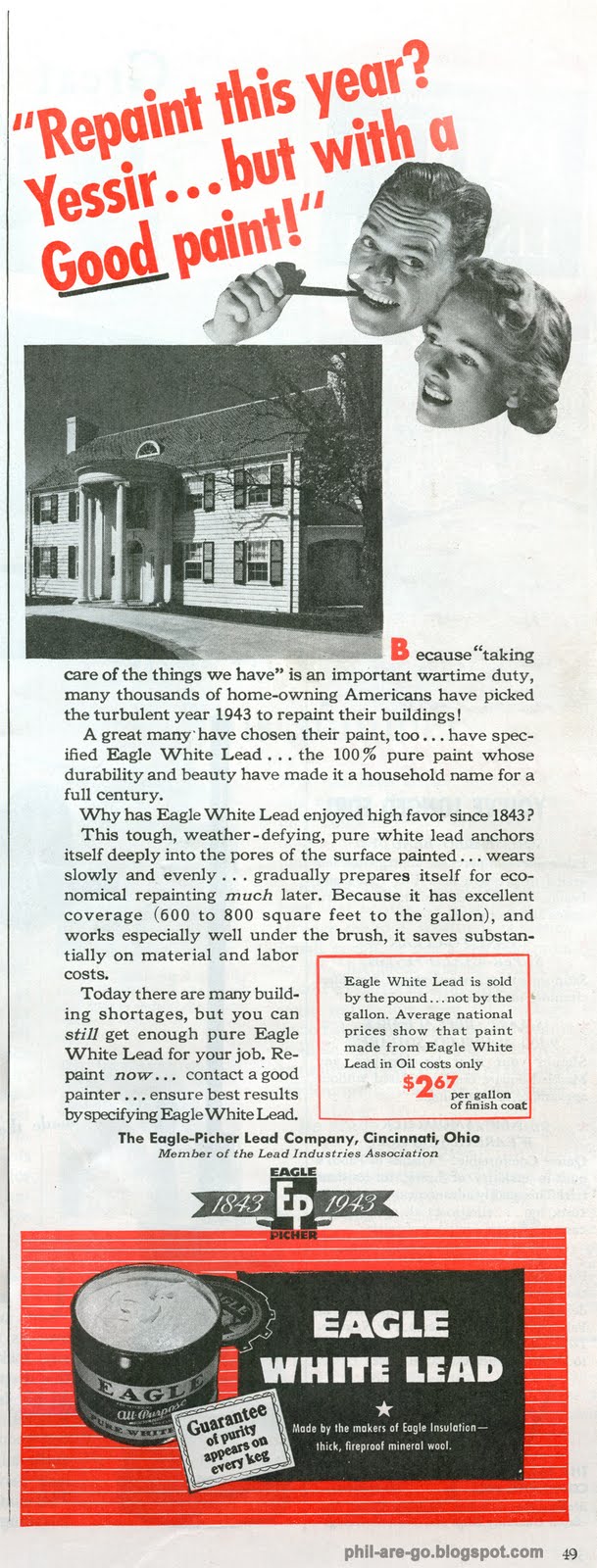
Lead, when added to paint, helps the paint in almost every way. It helps with adhesion, flow, and weather resistance. The delicious, peeling, flaky irony is that the very lead paint that the Eagle company was so proud of would have made a fine weapon for the war. Although it wouldn't have blown people up so nicely as explosives, it would however lead to stunted growth, delayed nervous system development, memory loss, headaches, abdominal pain, insomnia, delirium, cognitive impairment, vomiting, weight loss, kidney failure, learning disabilities, coma, seizures, and .... reproductive dysfunction! *Meeeeeroop*. Also lots more.
So, how early did we know lead was a bad paint ingredient and terrible cupcake topping? Well, according to the Wikipedia* article, Dioscorides, a second-century Greek physician, noted that Lead "made the mind give way". History is filled with observations and evidence that lead in your blood is super bad news. Soooo, lead paint was legal in the United States until 1977? Doubleyou tee eff? We can only speculate.
We can also speculate that the happy fella in the picture (one of a fine pair of Disembodied Floating Heads, by the way) may want to think about having children before he paints the house. technically, the ad isn't lying. Lead makes paint work very well, so long as you park your house on the moon and rent an apartment on Earth. It's doesn't help that Eagle White Lead came in in a container that made it look just like butter.
I was born before 1977, so I probably lived in a house that had lead paint in it. Am I fine? Maybe. Can I be sure I wouldn't be taller, smarter, or faster if I'd grown up in a forest instead? Maybe, but I craaf befoo woo fraaff blaaaf a faaaf.

* A note on Wikipedia: Wikipedia has been found to be nearly as accurate as Encyclopedia Britannica on scientific topics, in a study conducted by the science journal Nature. The more controversial a topic is (politics, religion, etc), the more likely it is that the Wikipedia article on that topic is to have errors, hyperbole, invective, or other useless opinion as part of it's content. In matters of science or history, Wikipedia is a really good source of information. Also, articles are flagged by editorial moderators if they don't cite their sources, or are poorly written. The Wikipedia article on lead poisoning has no such flags and LOTS of citations. It looks pretty air tight. For the casual researcher, Wikipedia is not infallible, but a pretty good tool if you know what to look out for.
6/16/10
AVE Mizar Flying Pinto - Boom, you're flying.
Ever seen one of the documentaries on the History And Superstition Channel about flight, made mostly out of stock footage of wacky old airship designs? Actually, since most shows on the "History" channel are about Bigfoots or UFO's, there's precious little on the network about anything that actually ever happened*, so better change that opening sentence to "Science Channel". Gotta make a not to have the editor swap that out.
Anyway, blah blah Science Channel something something wacky old failed airplane designs? Well, we may laugh, but we haven't really left that too far behind. Even Mythbusters routinely attempt to verify myths that can easily be discounted without practical testing at all. However, they re in the business of making entertainment first, and doing science second. So yes, the creation of wacky flying machines has not sloped off as aerodynamic understanding has ramped up.
 Popular Mechanics, 1973. Behold, the AVE Mizar flying car. It's a modified Pinto stuck to the underside of an airplane. AVE (whoever they were) regarded this machine as a "Pinto that sprouts wings". Well, that is clearly not the case, just by looking at it. A "flying car" would need to be a car that can be driven on the ground or flown like a plane. What the AVE Mizar is, is a 90% functional airplane - complete with it's own motor - which has been hobbled with a Pinto mounted to it's underside. The wings have their own motor, prop and fuel supply (airplanes carry their fuel in the wings). The Pinto is serving basically as a detachable cabin.
The problem with airplanes historically has not been "What to do with that pesky cabin once you land?" One may argue that there's a benefit to having your car go with one when one flies away, avoiding the nightmare of parking. Yes, but one would then have to find a place to park the giant wings in order to drive the Pinto away, after landing, wouldn't one? Parking a car is easier than parking an airplane. As a replacement for a conventional plane-and-car duo, the Pinto-stuck-on-a-plane idea solves no problem at all. In either case, you still need an airport at both ends of your trip to take off and land. You're just avoiding one parking fee, which you're exchanging for a 100% chance of looking silly and a 20% chance of exploding and being distributed evenly over the ground.
Apart from that, there's the wildly optimistic notion that every driver would be bright enough and coherent enough to carry a pilot's license. No offense to cell phone talking SUV drivers, but my life is threatened at least once per day by people driving SUV's while talking on the phone. I'd be delighted to have the "multitaskers" segregated into a lane of their own, or simply moved out of the way, say, into the sky. However, this would almost certainly insure that when - bear with me now - irresponsible drivers inevitably have an accident, we would then be faced with their cars plummeting earthward, instead of quietly folding the Escalade around a nice sturdy tree.
AVE's curious choice of modifying a Ford Pinto is.. uuh... curious (note to self: have editor make that sentence look less stupid). The Pinto is famous for it's mild explosion problem. Giving a Pinto an extra hundred gallons of fuel, stored in the wings, to ignite and then spray in all directions seems ill-advised. On the other hand, I am a stolid Darwinian, and I love the idea of allowing the dimwitted to take a permanent breather from the rat race. If only we could legislate a method for them to do so without taking out other, less useless humans with them.
 The flying car idea has not gone away. The most successful example at the time of this writing is the Moller Skycar, which relies entirely on props to maintain flight, as opposed to some kind of airfoil. The Moller Skycar has a ducted fan engine at each corner, powered by four Wankel rotary engines (made famous by the Mazda RX-7 and RX-8) driving each fan-pod.
Cool looking" Oooh, yeah. Safe? Nuh-uh. Upon laying eyes on this design, my dad immediately pointed out that, should the vehicle lose power, it would fall from the sky. Only the force of the motors keeps it airborne. Airplanes and even helicopters can return to Earth at non-fatal velocity in the event of power loss. A helicopter's rotor will "auto-rotate" as if falls, slowing the descent to possibly survivable speeds. The Moller would drop like a stone. If it loses power to only one motor, it's fate is less clear, but far from rosy. At least Moller borrowed parts from an RX-7, instead of a Pinto. The Wankel Rotary motor has always had a problem holding onto it's oil. They leak like a colander. This may bring some Moller Skycars back to Earth prematurely, but since the Pinto-based AVE-Mizar would probably just explode while airborne, the Moller would leave a smaller debris field to clean up, which is very considerate.
*Since every personal device larger than a Rice Krispy now has a camera in it, the amount of decent evidence (more then zero) for paranormal phenomena should have skyrocketed in the past decade or so. Despite this, convincing, plausible footage of bigfoot, aliens, and the chupacabra is not to be found. This leads any objective observer to declare such crypto-zoological monsters to be B.S.

Anyway, blah blah Science Channel something something wacky old failed airplane designs? Well, we may laugh, but we haven't really left that too far behind. Even Mythbusters routinely attempt to verify myths that can easily be discounted without practical testing at all. However, they re in the business of making entertainment first, and doing science second. So yes, the creation of wacky flying machines has not sloped off as aerodynamic understanding has ramped up.

The problem with airplanes historically has not been "What to do with that pesky cabin once you land?" One may argue that there's a benefit to having your car go with one when one flies away, avoiding the nightmare of parking. Yes, but one would then have to find a place to park the giant wings in order to drive the Pinto away, after landing, wouldn't one? Parking a car is easier than parking an airplane. As a replacement for a conventional plane-and-car duo, the Pinto-stuck-on-a-plane idea solves no problem at all. In either case, you still need an airport at both ends of your trip to take off and land. You're just avoiding one parking fee, which you're exchanging for a 100% chance of looking silly and a 20% chance of exploding and being distributed evenly over the ground.
Apart from that, there's the wildly optimistic notion that every driver would be bright enough and coherent enough to carry a pilot's license. No offense to cell phone talking SUV drivers, but my life is threatened at least once per day by people driving SUV's while talking on the phone. I'd be delighted to have the "multitaskers" segregated into a lane of their own, or simply moved out of the way, say, into the sky. However, this would almost certainly insure that when - bear with me now - irresponsible drivers inevitably have an accident, we would then be faced with their cars plummeting earthward, instead of quietly folding the Escalade around a nice sturdy tree.
AVE's curious choice of modifying a Ford Pinto is.. uuh... curious (note to self: have editor make that sentence look less stupid). The Pinto is famous for it's mild explosion problem. Giving a Pinto an extra hundred gallons of fuel, stored in the wings, to ignite and then spray in all directions seems ill-advised. On the other hand, I am a stolid Darwinian, and I love the idea of allowing the dimwitted to take a permanent breather from the rat race. If only we could legislate a method for them to do so without taking out other, less useless humans with them.

Cool looking" Oooh, yeah. Safe? Nuh-uh. Upon laying eyes on this design, my dad immediately pointed out that, should the vehicle lose power, it would fall from the sky. Only the force of the motors keeps it airborne. Airplanes and even helicopters can return to Earth at non-fatal velocity in the event of power loss. A helicopter's rotor will "auto-rotate" as if falls, slowing the descent to possibly survivable speeds. The Moller would drop like a stone. If it loses power to only one motor, it's fate is less clear, but far from rosy. At least Moller borrowed parts from an RX-7, instead of a Pinto. The Wankel Rotary motor has always had a problem holding onto it's oil. They leak like a colander. This may bring some Moller Skycars back to Earth prematurely, but since the Pinto-based AVE-Mizar would probably just explode while airborne, the Moller would leave a smaller debris field to clean up, which is very considerate.
*Since every personal device larger than a Rice Krispy now has a camera in it, the amount of decent evidence (more then zero) for paranormal phenomena should have skyrocketed in the past decade or so. Despite this, convincing, plausible footage of bigfoot, aliens, and the chupacabra is not to be found. This leads any objective observer to declare such crypto-zoological monsters to be B.S.

5/20/10
GE Sunlamps - Alleged healthy glow.

Joke #2: "Awww, honey... you popped my favorite pimple! Now what am I supposed to sing show tunes to?"
Joke #3: GE's new Smuglamps will give you that smug douchebag look all year 'round! Just three exposures per day of one hour each, and GE's patented Smugwaves will penetrate and nourish your skin, turning you a rich, smug douchebaggey color that your wife/mistress/girlfriend/genetic clone will absolutely adore!
Joke #4: Honey, your tie's crooked. Let me fix it for you, but please don't headbutt me. Hey! I said DON'T headbu- *thunk!*

Joke #6: "I'm sorry, sweetie-pie. They don't allow children in Florida. Here's a sunlamp and a little beach ball. Water's over there, in the toilet. We'll see you in a week, okay? Aww, that's my little angel."
Joke #7: Are you tired of other babies getting all the attention from women? GE's sunlamps are now approved by GE for baby use! Your baby will be a healthy bronze color and h - o - t, hot! Don't wait up, mom! Junior's got a date, heh heh!
Joke #8: "I'm sorry sweetie-pie. They don't allow semi-amphibious subterranean wretches in Florida. here's your Precious, and I'll turn on the Yellow Face to keep you warm. Fish are over there in the toilet. We'll see you in a week, okay? Aww, that's my little Smeagol."

1/14/10
Household Inventions - Asbestos we can make them!
In 1945, Popular Mechanics ran this piece about new household inventions. There is no mention of who invented them, if they were ever sent to market, or even if these were working models in the photographs. They could easily be mockups put together just to demonstrate the idea for the photo shoot.

The combination clothes/dish washer is something I've wondered about before. Why buy two large machines to do what is more or less the same job? You'd think it'd be possible to make one machine that can do either. I guess it's not so easy, or the idea would have caught on. I'm not sure why, though.
It's kind of weird that somebody saw the need to design a thing that dries out clogged salt shakers. I'm a pretty astute observer of the physical world, and I like to find out little bits of domestic scientific trivia, but I didn't know that glogged salt shakers were a big problem. Also, I didn't know that the problem was caused by moisture. So, I guess we need to invent a salt shaker dryer to take up space on your kitchen counter for 364 days out of the year when you don't need it. Well, actually, it seems we don't need that, or you'd see them in stores by now, wouldn't you?
And now for the real star of the show: the Asbeston ironing board. No no no. Don't say "asbestos"! Asbestos was already beginning to gain attention as Something Seriously Bad For You in the 1940's. Let's see if I can summarize why it's bad. Asbestos is a natural mineral that forms very long, very thin crystalline fibers that don't burn, which is pretty neat. Much less neat is the fact that, if you get them on or in your body, your body can't get rid of them because the fibers are too thin, and as a reaction, forms an inflammation that never goes away. On the surface of the skin, it forms warts around the asbestos fibers. In your lungs, it becomes mesothelioma and kills you in fifteen years.
Anyhoo, this ironing board is made from "Asbeston". See what they did there? They changed the last letter of "asbestos" into an N. So, it's really a totally different material that has identical properties to asbestos, but with a trademarkable name and probably none of the icky drawbacks of the letter S version of the stuff, as far as you know. So, you're ironing your clothes on a fabric called "Asbeston". Put on that shirt. Rub it on your skin. Breathe all you want, because there's no S!
Also great household ideas...
"Ebolan" Disinfectant Spray - Safe until we discover it in 1976!
Bright Bottom Baby Powder - Now with "Uraniun", for a little extra comforting warmth!
Leprosyn Dish Soap - Baked on food just melts away!
Cancerol Pain Reliever - You only take it once!
Cirrhosin Country Ale - Embrace the inevitable... in Cirrhosin Country!

It's kind of weird that somebody saw the need to design a thing that dries out clogged salt shakers. I'm a pretty astute observer of the physical world, and I like to find out little bits of domestic scientific trivia, but I didn't know that glogged salt shakers were a big problem. Also, I didn't know that the problem was caused by moisture. So, I guess we need to invent a salt shaker dryer to take up space on your kitchen counter for 364 days out of the year when you don't need it. Well, actually, it seems we don't need that, or you'd see them in stores by now, wouldn't you?
And now for the real star of the show: the Asbeston ironing board. No no no. Don't say "asbestos"! Asbestos was already beginning to gain attention as Something Seriously Bad For You in the 1940's. Let's see if I can summarize why it's bad. Asbestos is a natural mineral that forms very long, very thin crystalline fibers that don't burn, which is pretty neat. Much less neat is the fact that, if you get them on or in your body, your body can't get rid of them because the fibers are too thin, and as a reaction, forms an inflammation that never goes away. On the surface of the skin, it forms warts around the asbestos fibers. In your lungs, it becomes mesothelioma and kills you in fifteen years.
Anyhoo, this ironing board is made from "Asbeston". See what they did there? They changed the last letter of "asbestos" into an N. So, it's really a totally different material that has identical properties to asbestos, but with a trademarkable name and probably none of the icky drawbacks of the letter S version of the stuff, as far as you know. So, you're ironing your clothes on a fabric called "Asbeston". Put on that shirt. Rub it on your skin. Breathe all you want, because there's no S!
Also great household ideas...
"Ebolan" Disinfectant Spray - Safe until we discover it in 1976!
Bright Bottom Baby Powder - Now with "Uraniun", for a little extra comforting warmth!
Leprosyn Dish Soap - Baked on food just melts away!
Cancerol Pain Reliever - You only take it once!
Cirrhosin Country Ale - Embrace the inevitable... in Cirrhosin Country!
1/13/10
Union Carbide Car Seat - It's not like we're running out of babies.
Here's a partially safe car seat from 1963, brought to you in vivid halftone and no color, to de-emphasize the blood stains. Union Carbide, the company that pretty much invented the petrochemical industry, is now part of Dow chemical, who brought you Styrofoam and agent orange. Here's what happens when they first tried their hand at designing something to keep small humans safe.
 Surprisingly, the Ever Soft car seat is mostly constructed from steel tubing and not so much from plastic, which would have been at least a little less "stabby-pinchy".
The following is excerpted from the Ever Soft information manual (Copyright 1962 Union Carbide, Inc.)
You'll notice the exposed hinges, where the Infant Restraint Barrier (IRB) pivots down against the Primary Seating Module (PSM) in a delightful scissoring action. Fortunately, babies aren't known for their curiosity and searching fingers or this would be a hazard.
Next, notice that the whole device hangs over the back of the car's seat. You may think that this doesn't provide much security in the event that you drive over a medium sized bump, but let's remember that this is the greatest country in the universe, and American roads are paved with cast iron that is leveled with a laser T-square, and they never ever degrade or form potholes. Don't say they do. What are you, a communist?
Moving on, you can see that the Infant Restraint Barrier (IRB, remember) is conveniently held in the upright position by a hook, during the critical Infant Insertion and Immobilization Procedure (IIIP). During transport, the hook remains up and out of the way, several inches above the child's skull, or Brain Containment and Command Module (BCCM). This could, in a less perfect universe, theorhetically be considered dangerous, except for the fact that American drivers are the most courteous, conscientious, and resposible drivers in the totality of the multiverse, and road accidents haven't been a reality since the Great Chariot Collision of 612 B.C. Also, let's recall that the Ever Soft is securely draped over the back of the seat, and can't possibly come loose, stupid.
Sadly, the Ever Soft car seat failed to sell well. In an attempt to recover some of their production investment, the Union Carbide corporation shipped the entire stock of Ever Soft car seats to Viet Nam in 1965, dropping them over Hanoi as part of the de-population effort. The casualties were hailed as "apocalyptic and glorious" by the Ever Soft development team.

The following is excerpted from the Ever Soft information manual (Copyright 1962 Union Carbide, Inc.)
___________________
You'll notice the exposed hinges, where the Infant Restraint Barrier (IRB) pivots down against the Primary Seating Module (PSM) in a delightful scissoring action. Fortunately, babies aren't known for their curiosity and searching fingers or this would be a hazard.
Next, notice that the whole device hangs over the back of the car's seat. You may think that this doesn't provide much security in the event that you drive over a medium sized bump, but let's remember that this is the greatest country in the universe, and American roads are paved with cast iron that is leveled with a laser T-square, and they never ever degrade or form potholes. Don't say they do. What are you, a communist?
Moving on, you can see that the Infant Restraint Barrier (IRB, remember) is conveniently held in the upright position by a hook, during the critical Infant Insertion and Immobilization Procedure (IIIP). During transport, the hook remains up and out of the way, several inches above the child's skull, or Brain Containment and Command Module (BCCM). This could, in a less perfect universe, theorhetically be considered dangerous, except for the fact that American drivers are the most courteous, conscientious, and resposible drivers in the totality of the multiverse, and road accidents haven't been a reality since the Great Chariot Collision of 612 B.C. Also, let's recall that the Ever Soft is securely draped over the back of the seat, and can't possibly come loose, stupid.
___________________
Sadly, the Ever Soft car seat failed to sell well. In an attempt to recover some of their production investment, the Union Carbide corporation shipped the entire stock of Ever Soft car seats to Viet Nam in 1965, dropping them over Hanoi as part of the de-population effort. The casualties were hailed as "apocalyptic and glorious" by the Ever Soft development team.
12/21/09
Baby Cot - Prepped for launch!
 In the interest of national defense, our trusty British allies designed for us this tactical baby launcher. (Click on picture for larger, more readable version.) It could be cleverly deployed in the yard (or "garden" as the Brits call it) looking like any ordinary baby cot, looking for all the world like the cots the baby army slept on in their baby barracks.
But, should the Russians invade your nation, the baby cot could be quickly installed in a vehicle, making every family car a potential piece of baby-firing artillery. The proud parents would simply speed towards the target and slam on the brakes. The baby would then be launched through the windshield. Assming the baby had been primed with an explosive or incindiary charge, the enemy would in all likelihood snuff it... or be completely freaked out.
Unless, of course, the communists just chose to launch a missile at us. That would have made the tactical baby obsolete overnight. And sudden missile attack was what the whole cold war was really about the whole time anyway. Hmm. This whole "cold war" thing is more complicated than it seems.

12/15/09
Riverview Flying Cars - No injuries... yet.
A lot of my friends' parents talk with moist-eyed happiness about Riverview Park, a Chicago amusement park that existed from 1904 to 1967. Life ran this page about the Flying Cars ride in 1957. The safety precautions of the time are slightly hilarious.


These are not complaints. I'm in favor of people with poor judgement being allowed to horribly mutilate themselves in public for the greater good. It's just that, from the perspective of a person used to having a yellow padded horse collar drop down over my head whenever I got on the Shockwave, the Flying Cars ride looks really... what's the word?... "homebrewed", like something a guy would build next to his doublewide, without any oversight or forethought. It not only looks homebrewed, but also "home-investigated-by the-local-authorities", "home-subpoena'd", and "home-subsequently-serving-time-at-a-state-run-facility'd."

Click on the picture for a high resolution version you can read for yourself. The ride worked like this: the drum was motorized and the cars were freewheeling, held onto the drum by a flanged rail and floating clamp system. The drum rotates up to speed and the cars let it roll beneath their wheels. Then, the cars' brakes are applied, quickly accelerating up to the 30mph speed of the drum's surface. Patrons spin around the drum for two minutes before the brakes are released, letting the cars wobble to a standstill while the drum also slows to a halt.
Looking at the thing, I'm amazed that no one was hurt (according to the article, which is according to the park, which is not likely to publicize any injuries). The patrons are asked to keep their hands inside, just like any roller coaster, but look how easily some idiot could reach down and grab the car's wheel. The people are "tightly strapped in" by one belt across their stomachs. Their heads are free to flop around well above the body of the car, enjoying zero neck supprt. When the brakes are engaged and the cars accelerate, what happens to your neck? Maybe it's a trick of perspective, but it looks like those waiting in line seem really close to the machine itself.

These are not complaints. I'm in favor of people with poor judgement being allowed to horribly mutilate themselves in public for the greater good. It's just that, from the perspective of a person used to having a yellow padded horse collar drop down over my head whenever I got on the Shockwave, the Flying Cars ride looks really... what's the word?... "homebrewed", like something a guy would build next to his doublewide, without any oversight or forethought. It not only looks homebrewed, but also "home-investigated-by the-local-authorities", "home-subpoena'd", and "home-subsequently-serving-time-at-a-state-run-facility'd."
12/4/09
Fiberglass - May be hazardous. Have your daughter do it.
Fiberglass is weird stuff. It's still debated whether or not it's a carcinogen. Mostly, the anti-fiberglass people are bothered by it's similarity to asbestos fibers. The difference is that, when glass fibers break into smaller particles, they only break across the fiber, giving you little crumbly bits. Asbestos fibers can only break longditudinally, or along the length of the fiber, resulting in ever thinner, pointy little spears. When inhaled, your body can't shake them loose. You can't cough them out, and they stay there forever, irritating your lungs and possibly killing you as a disease called mesothelioma. Glass fibers can be expelled from your lungs, and as of yet, fiberglass is not considered a carcinogen.
 Yeah, great and all that. Fiberglass still has lots of other unpleasantness to offer. Fibers can lodge in your skin and cause irritation. Inhaled particles can cause coughing and nosebleeds. OSHA guidelines recommend wearing a respirator, several pairs of gloves, a space suit, and a backup spacesuit in case you snag your first spacesuit on a nail crawling around your attic, which you will. Of course, the sticker on your hammer insists that you wear goggles and a hardhat every time you even look at the thing. So, grain of salt.
Apparently, in 1958, the hazards of fiberglass weren't understood. At the time, fiberglass had been on the market for twenty years, but apparently everyone blamed their itchy skin on communism or something. Until I saw this ad, I didn't even know fiberglass was used to make air conditioner filters. That's kind of horrifying - blowing air through fiberglass to distribute fibers into your house for easy inhalation all summer long.
 In panel three, they show the little girl (with the creepy retouched eyes) holding the filter with her bare hands. Yikes. When I insulated my attic, I wore a bunch of clothes to keep from touching the stuff, and when it accidentally brushed my wrist, it brought on a barely suppressible attck of the heebie jeebies. After the attic ordeal, I had a cold. brutal shower like in Silkwood.
Incidentally, if you get fiberglass in your skin, it's better to wash the area with cold water. Warm water will open your pores, encouraging the fibers to work their way farther in ...unless you're a darling little girl, I guess. Then it's okay to have an Owens-Corning sandwich for supper and sleep under a blanket of R-30.
 Yeah, great and all that. Fiberglass still has lots of other unpleasantness to offer. Fibers can lodge in your skin and cause irritation. Inhaled particles can cause coughing and nosebleeds. OSHA guidelines recommend wearing a respirator, several pairs of gloves, a space suit, and a backup spacesuit in case you snag your first spacesuit on a nail crawling around your attic, which you will. Of course, the sticker on your hammer insists that you wear goggles and a hardhat every time you even look at the thing. So, grain of salt.
Apparently, in 1958, the hazards of fiberglass weren't understood. At the time, fiberglass had been on the market for twenty years, but apparently everyone blamed their itchy skin on communism or something. Until I saw this ad, I didn't even know fiberglass was used to make air conditioner filters. That's kind of horrifying - blowing air through fiberglass to distribute fibers into your house for easy inhalation all summer long.
 In panel three, they show the little girl (with the creepy retouched eyes) holding the filter with her bare hands. Yikes. When I insulated my attic, I wore a bunch of clothes to keep from touching the stuff, and when it accidentally brushed my wrist, it brought on a barely suppressible attck of the heebie jeebies. After the attic ordeal, I had a cold. brutal shower like in Silkwood.
Incidentally, if you get fiberglass in your skin, it's better to wash the area with cold water. Warm water will open your pores, encouraging the fibers to work their way farther in ...unless you're a darling little girl, I guess. Then it's okay to have an Owens-Corning sandwich for supper and sleep under a blanket of R-30.
Subscribe to:
Posts (Atom)



 Posts
Posts



