Today we bring you a doozy of a clip art, courtesy of the Institute of Applied Science in 1948.
Study at home, blah blah, fingerprints, blah, write for free pamphlet, blah blah. CRUSH PERPETRATORS AND MISCREANTS IN YOUR GIANT FIST! SEE THEIR VISCERA SPURT FROM YOUR FINGERGROINS! Yes, please!
You need this clip art in your computer. You could use it for almost anything. Emails from the Human Resources department, for example, or an invitation for a Ladies' Night Out. Just about any occasion where you feel the need to convey absolute hideous control and horrific disregard for all humanity, this clip art will be there for you, ready to help let the world know how you feel. Maybe you're a plucky young upstart and you need a logo for your Presidential bid? We've got your covered. Get your rude finger ready to right click this little doodle onto your hard drive in three, two, one, right click now, you crazed despot.
It looks like the long, enormous arm of the law scraped clean the streets of Victorian London. I can see Fagen, and about seven other ne'er-do-wells called "Stabby McGee" or something. It's good to know what kind of criminals were crawling the streets of America in 1948, and that they were the size of army men. You're welcome.
Today is the final day of Music Week, and we present to you a person that probably nobody hates. When his songs come on the air, is there anyone who says "Oh god. This frikkin guy. I'm leaving the room an an angry fashion immediately."?
You may recognize his name. We're entering the Vince Guaraldi time of year, when you'll be hearing his music in all the Charlie Brown holiday specials. But, you can assign your self some musical street cred bonus points by getting his Greatest Hits album, which features a lot of music from his career before he ever got the Peanuts gig. Yes, that's right! He had a life before Charlie Brown!
Guaraldi's recording career started in the early Fifties, on an album with the fantastic jazz vibraphonist (No, I'm not being sarcastic) Cal Tjader. He eventually started his solo career in 1959, and did a lot of great stuff before being knighted the Charlie Brown Minstrel in 1965 with the release of A Charlie Brown Christmas.
His style, like a lot of 60's era jazz, was heavily influenced by sambas and other Brazilian rhythms, which were brought back to America by soldiers returning from World War II. See? War. Ughhh. Good gawd yaww. That's what it's good for!
Dig the Ginza Samba...
Cast Your Fate to the Wind was Guaralid's big grammy winning hit from 1963, and basically won him the Charlie brown gig when the animation producer Bill Melendez heard the song and asked Guaraldi if he would do some music for a little project he had coming up.
The rest is seasonal TV history. But, do yourself a favor and hip yourself to the samba jive by making the scene on his earlier career. It's just as charming, but you can still feel like a sophisticated grownup and stuff when you put it on.
Have you always wanted to get a little classical music in your collection, but just something a little more substantial than frilly, flopsy Mozart (not that there's anything wrong with that)? Today's musical recommendo may have the cure for your classically curious blues: Gustav Holst's The Planets.
Gustav! How's it hangin, baby? You're looking a little intense there. Let you music take care of that instead. Give us a little smile, my man.
The Planets has one "song" written for each of the seven planets known to exist at the time. Each has a distinct character, borrowing from mythology to assign personality to each planet. Each planet has a job. Neat!
Mars, the Bringer of War
Venus, the Bringer of Peace
Mercury, the Winged Messenger
Jupiter, the Bringer of Jollity
Saturn, the Bringer of Old Age
Uranus, the Magician
Neptune, the Mystic
Gustav Holst (1874 - 1934) was an English composer whose influences include Vagner, of Ride of the Valkyries fame, and Ravel, of Bolero fame. This makes complete sense once you get through The Planets for the first time.
Vagner's ridiculously large opera The Rings of the Nibelung is so long it has to be broken up into several days of opera-ing. Lots of apocalyptic imagery and screaming choirs - good! Fifteen hours of turgid epic drama - possibly bad. The Planets has that, but in a less forbidding size. Just drop the needle on Mars, Bringer of War. Perfect soundtrack for your standard issue category three tornado or D&D gaming session. Mars is a thundering planetary death knell in 5/4 time. Because of this, it's a pretty useful and popular piece of music. So, you've probably heard it before: It's found its way into lots of commercials and movies. It's the heavy metal of orchestral music. Skip to one minute in this video for the start of the music. Or, just jump to 8:26 to hear the end of the world.
Another Holst influence, Ravel's Bolero starts quiet and gets louder as it repeats its main theme, sounding mysterious and exotic the whole way. The Planets has this too. Look up Uranus, the Magician, or Neptune, the Mystic. The dissonant (notes that intentionally don't match) chords sung by the choir in Neptune still give me the creeping heebie jeebies every time. Skip to 5:07 in this video to make all of your hairs stand up.
Unlike your tea-and-cakes kind of chamber music, The Planets offers those with orchestral curiosity something to sink their teeth into, without needing a doctorate in history. It's a good gateway drug into classical music, if you don't want your CD shelf (if you still use those) to look like you inherited your collection from your grandma... even though mine totally does.
Here comes Jupiter, Bringer of "Jollity". Good old Jupiter, with his abundtive jollity. So jovious and whimsitive! Sometimes it's hard to tell if history actually used to use words like "jollity" or if it's just making shit up to screw with our grammar. Let's play it safe. Just go around ramming different suffixes onto words that don't have matching plugs, and tell anyone who complains to "look it up, you troglodyte. I'm listening to classical music!" Get your music-holes ready to have jollity crammed into them. Jolly up, you!
So there's The Planets. It's got some happy stuff, some light warfare, some spooky crap going on, and various other emotions, like going really fast (Mercury, the Winged Messenger). You could do worse.
Homewrecker, or just your sexy muse?
Be careful, though, just like suddenly going to the gym on a regular basis, starting a little classical music habit may have your husband, wife, or wifeband suspecting you're cheating with a college professor... or Arthur Fiedler.
Music Week continues today. It's time for some foreign jazz imitating American jazz.
I know, I know. You don't get anime. That's fine. Even though Cowboy Bebop is the only anime show that seems to be made for grownups and carefully avoids all the weirdnesses that would turn off the casual viewer, you completely don't have to watch the series to understand how good the music is. Also, the English dub is so well-performed you could forget it was ever in a different language in the first place, which is a rare, rare thing among anime dubs.
Yoko Kanno, as she would be called in the States. In Japan, you
would call her Kanno Yoko - Family name first, and then your
own name. Kind of a nice idea. This is how it is in most of Asia.
The show is set in 2071, on Mars and Earth, starring a couple of bounty hunters that don't really like each other. So, of course the natural fit, when it comes to the music, is Sixties-sounding American jazz, right? All the music for the show was written by Yoko Kanno. She also conducted the band she assembled to record all the tracks, calling themselves The Seatbelts. She's kind of a musical genius. How good was the music? A couple of years after the show ended, The Seatbelts went on a tour of Japan doing concerts of the soundtrack to sold-out audiences. Who could say no to a twenty-whatever piece big band playing music to have fight scenes by?
Enough talk! Stare with your ears. Here is the opening title sequence to the TV show. The theme song is called Tank!
More. This is Rush, also on the O.S.T. 1 album (which stands for Original Sound Track, by the way).
The recordings have a retro sound to them that is definitely not accidental. Ever since roughly The Sixties, audio engineers will tend to record a band by "close mic'ing" them, with each horn getting its own microphone, sometimes shoved deep into the bell of the instrument. This reached its height of popularity in The Seventies. This is how you get that sound that each instrument is sitting right inside your head. A good example of close mic'ed horns can be heard in pretty much any studio album by Steely Dan, but here's My Old School. Notice how the horns sound like you're sitting right in front of them. This is the sound of The Seventies. Tight and dry, with little or no reverb.
With these Cowboy Bebop recordings, you can hear a lot of "room ambience". The musicians were very likely recorded by two microphones (gotta have stereo separation!) positioned overhead, covering the whole group. This has the effect of letting you hear the whole band, as they sounded in a large room. This is how things were done up until the early Sixties and for the whole of recording history before then. By using this recording technique, Kanno further positions her musical sound in the past, giving it a retro feel that you definitely perceive, maybe without realizing it. This method is sometimes used today, whenever the engineer wants to get a more natural sounding recording, or "that retro sound".
Oof. A quick check of Amazon shows us that pretty much any Seatbelts CD is going for thirty to fifty dollars, apparently because they're only available on an import basis. Shit. This is not a reasonable first-time purchase for the casual listener. Maybe if you're resourceful you can find it some other way, or maybe one one of your new-to-medium-fangled streaming services?
As long as we're through the looking glass of outrageous music prices here, let's watch just about the coolest chase scene ever committed to film and the accompanying song, What Planet is This. The song is on a different and similarly outrageously overpriced album, the soundtrack to the Cowboy Bebop Movie, released in 2003, Cowboy Bebop O.S.T. Knockin' on Heaven's Door / Future Blues. Skip to 1:13 when the scene kicks into high gear as the music starts, or watch from the start to see all the hand-drawn tracer fire and smoke trails you can possibly see. Sorry we couldn't find this clip on FaceTube with the English dub.
I've read before that the Japanese regard American culture the same way we do French. They think it's cool, and like to borrow it from time to time to add some style to their own. Cowboy Bebop makes a strong case for this notion. Cowboy Bebop uses ultra-hip music to make sure you understand that violence and mayhem make brilliant entertainment. Mission accomplished, The Japanese.
As music recommendos go, this one is getting depressing. No one should be asked to pay forty-ish dollars for a frikkin CD. Maybe this year's Surprise Pointy Tree Day Card CD Gift needs to have a few of these easy-to-find-but-expensive-to-buy tracks on it? Food for thought.
Music Week continues today, with something for those with a stomach for quirk. No? No quirk stomach? How's your idiosyncratic stomach? "No" on that as well? Umm, you may want to come back tomorrow.
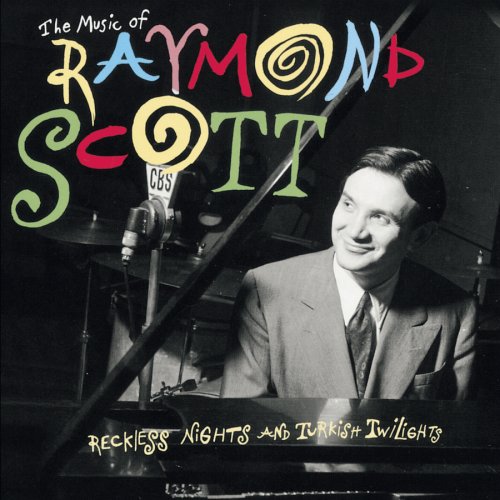
If you stayed... so, maybe you're pretty weird, and you like (small) big band type music but also something old timey, and you want a dose of cartoons in there as well. You're in luck, you musical sociopath, because Raymond Scott has you covered!
If you were a child at one point, and also lived in or near a house with a television set between the years of 1940 and 1990, you will instantly recognize several of Scott's songs. Try this on for size. It's called Powerhouse, and you know it, but not because of the reason you think you do. You may have to wait till 1:28 to get to the familiar part, though.
"Oh yeah! you say. That's the song that what-his-face wrote for the Bugs Bunny cartoons! What's the guy? Carl Stalling! Yeah!" WRONG! You're WRONG! And please sit down!
Carl Stalling sort of "borrowed" Powerhouse along with the rest of Scott's catalog for use in cartoons, due to Scott's sale of his publishing rights to Warner Bros in 1943. You'd be forgiven for thinking Stalling wrote Powerhouse, but Raymond Scott (actual name Harry Warnow) wrote it about ten years earlier. Forget Carl Stalling.
Scott began his career as the pianist in the CBS orchestra in The Thirties. All the while, he wrote music on the side that was altogether crazier and more dense than anything his professional life required of him. He assembled a band out of a few CBS orchestra colleagues and started his six-piece band, the Raymond Scott Quintet.
He called his music "descriptive jazz", which is why the songs have titles like "Dinner Music for a Pack of Hungry Cannibals." His brilliant craziness meant that his music found a home in one cartoon after another for decades to come. Scott's music found its way into cartoons like Looney Tunes, Ren & Stimpy, The Simpsons, Animaniacs, Duckman, and others. He wasn't writing music for cartoons. He was just writing music that suited himself, but cartoon makers have embraced his stuff ever since. The music in his head turned out to be perfect for cartoons. How's that for a weirdness pedigree?
Scott took some heat from musical purists at the time for sometimes incorporating classical melodies into his music. They saw it as a debasement of their musical culture. However, if you, like me, owe your early classical music exposure to cartoons, this is no bad thing. It turns out there are lots of people who first became interested in orchestral music because of its use in cartoons. So, as usual, those people losing their shit were freaking out over nothing.
In 1992, a number of unreleased recordings were discovered and subsequently released on the Columbia label as the album Reckless Nights and Turkish Twilights.
Here's an link to Amazon's page for the album, which you can buy on CD for five bucks, or download compressed MP3's for... ten dollars? I say get the disc and you can re-rip it again and again down the road at higher and higher bitrates as storage becomes cheaper and cheaper, but that's just my musical consumption philosophy in general. Physical media, all the way, baby, and don't tell me what I can and can't do with my own files. Okay, editorial complete.
Here are some songs you din't know you knew:
In an Eighteenth-Century Drawing Room, which rankled the snobs because Scott grabbed the melody from Mozart's Piano Sonata in C Major...
The Toy Trumpet, which you may recall from the Ren & Stimpy episode "In the Army" and probably some other places. Don't ask me what's with the people on the train in the picture.
But the big hit everyone recognizes is still Powerhouse. How big? Rush used a little bit of it in their nearly-impossible-to-play-in-one-take song "La Villa Strangiato". In this embedded video, skip to 6:05 to hear the little nod to Powerhouse.
You can find other compilations of Raymond Scott's music, including the re-recordings by the Dutch jazz group The Beau Hunks, playing faithful versions of Scott's hits on period-correct instruments (jeez!). But Reckless Nights and Turkish Twilights is the album that brought Scott back to the record store shelves, and is probably the best place to start.
That can be your good dose of vitamin Crazy for the day.
Guess what, guessers! Wrong! This week is Music Week here at GO! Tower! That means we've pulled five albums from the P.A.G! Twelfth Floor Employee Lounge Close-N-Play Jukebox, and we will present reviews of these albums all week long.
Today we begin Music Week with Mississippi John Hurt, the blues man for the blues-intolerant listener.
I know what you're saying. "I want me some blues in my collection, but as a musical form, the blues are too repetitive and simplistic. I get bored listening to the blues! Surely there must be some kind of blues that doesn't follow the predictable chord progressions and stereotypical forms of the genre."
Good thing you're saying that, because Mississippi John Hurt is here to salve the soul.
Mississippi John Hurt has all the blues pedigree you could ask for. Born during the age of the steam engine, check. Self-taught guitarist, check. Sharecropper, check. Played around the deep south throughout the Great Depression, playing dances while working as a farmhand, oh, big check there!
His career would have ended around 1940 or so, except that his music enjoyed a bit of a rediscovery in The Fifties, with the rise of coffee house culture. The album pictured to the left, "Today!", was recorded in 1966, shortly before his death. It's a clean studio recording of Hurt at the end of a long and varied career. So, you won't have the scratchiness of old wax cylinders or anything like that... although there are other Mississippi John albums recorded live, and on questionable equipment, if that's the sound you're after. On "Today!", the only scratchiness will come from Hurt's voice.
"Today!" is a tight thirty minutes or so of Hurt playing pretty much his best songs. The songs are usually a tidy two minutes thirty seconds or so: no longer than they need to be. His playing style was developed kind of in a vacuum, with few outside influences. As a result, he sounds only like himself. His playing is a quiet and intricate picking style that is a departure from any other blues you will find. Also, the structure of his songs bears no resemblance to the predictable and repetitive twelve bar progression that, in my opinion, smothers the interestingness out of almost all other blues.
Here's "Pallet on your Floor", which demonstrates his signature picking style:
Another big favorite of mine is Pay Day. Guess what it's about?
Candy Man is pretty dirty, with the lyrics only thinly veiled in metaphor. Fun enough for you. Safe enough that your kids won't catch on.
You can put on Mississippi John really early in the morning without jarring yourself into waking up too fast, or annoying whoever hasn't gotten out of bed yet. Having a drink before your guests arrive? Mississippi John's your guy. Driving home after a super loud concert? Mississippi John.
Doing some two-beer carpentry in the garage? Oh, you bet Mississippi John.
On other Mississippi John albums, there are some funny songs like "Funky Butt Blues" ("Funky butt, stinky butt, take it away"), but "Today!" is the definitive Hurt album, and may be the only one you really need.
Mississippi John helps you think. It's ten dollars. Buy "Today!", and here's what you'll never say: "God dammit! I wish I hadn't bought that Mississippi John album! What was I thinking?"




 Posts
Posts