Showing posts with label cameras. Show all posts

4/9/22

Vintage Soviet era Helios 40 lens cleaning and refurb.

Disclaimer: Old Soviet lenses are interesting to use, and can be found pretty easily at reasonable prices (okay, not this lens, but still). Ownership of, and interest in, these lenses should not be interpreted as approval of the Russian government's actions or policies. This should not need to be pointed out, but this is the internet, so..... yeah. Just saying.

A Helios-40 lens. It was made in 1961, and is sought after by vintage lens weirdos for its crazy swirly bokeh. It's pretty hard to find, making it the most expensive vintage lens I have. It was around $350. It's a huge lens, considering it's not even a zoom lens. There's a lot of glass in it. They don't appear often, and they're famous for being "The Bokeh Monster". So, they command a premium, considering it's an old mechanical lens.

The optical section on the left, having been separated from the helicoid (on the right), which is the target of this project. No way was I going to take apart the optics, even if they do have a few specks of dust. My mission was to clean and lighten up the focus ring action. Soviet-era Russian lenses are said to have been lubricated with tank grease. This one sure felt like it. Stiff and gummy. Trying to turn the focus ring often unscrewed the lens from the adapter holding it on the camera. This is unfavorable.

Scratch marks indicate where parts need to be clocked (rotationally positioned in relation to each other) for proper function when reassembled. There were already some scratches on the parts, indicating that someone had been in here before.

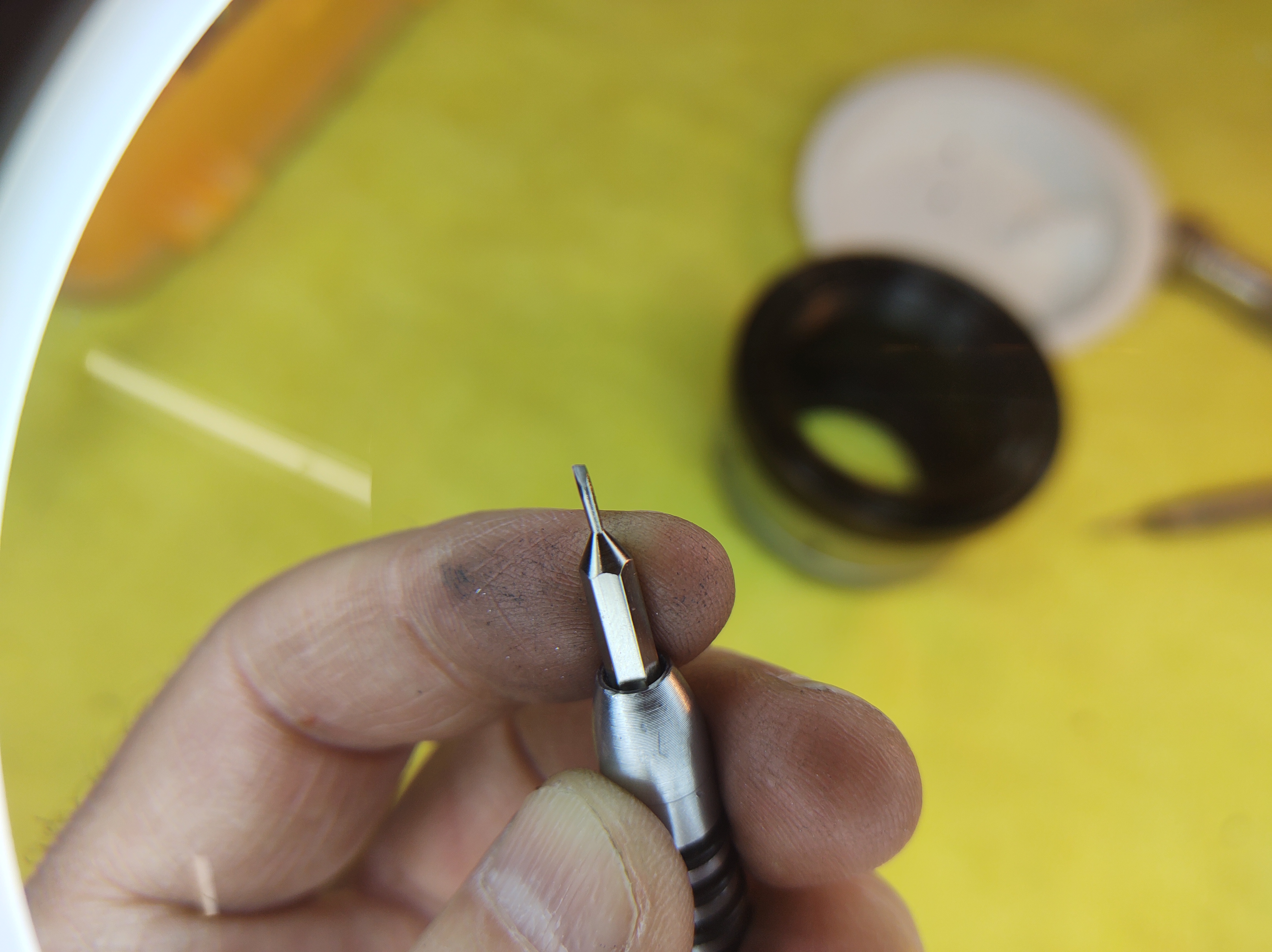
2mm screwdriver. It required frequent "resharpening" with a whetstone.

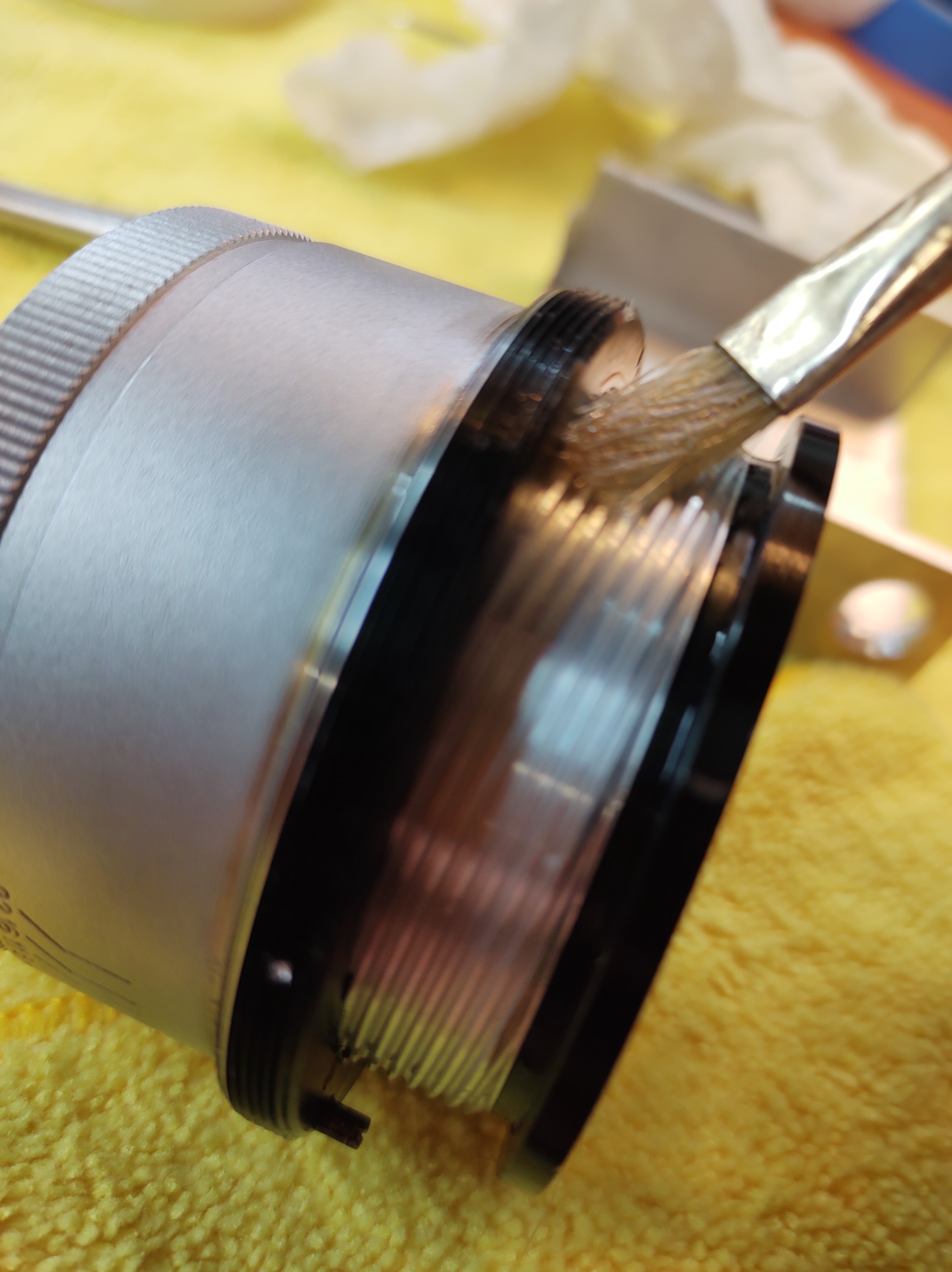
Note the thick and filthy alleged "tank grease".

The large threads are the helicoid, which is how the lens focuses. There are about 16 parallel threads in it, instead of like one or two. This means if you get the threaded parts engaged in one of the fifteen wrong combinations, the lens won't work right when you put it back together. Between the scratch marks already on it and the ones I added, I got confused about the orientation and I absolutely put it back together wrong... several times. Whee.

All the components of the helicoid, unassembled.

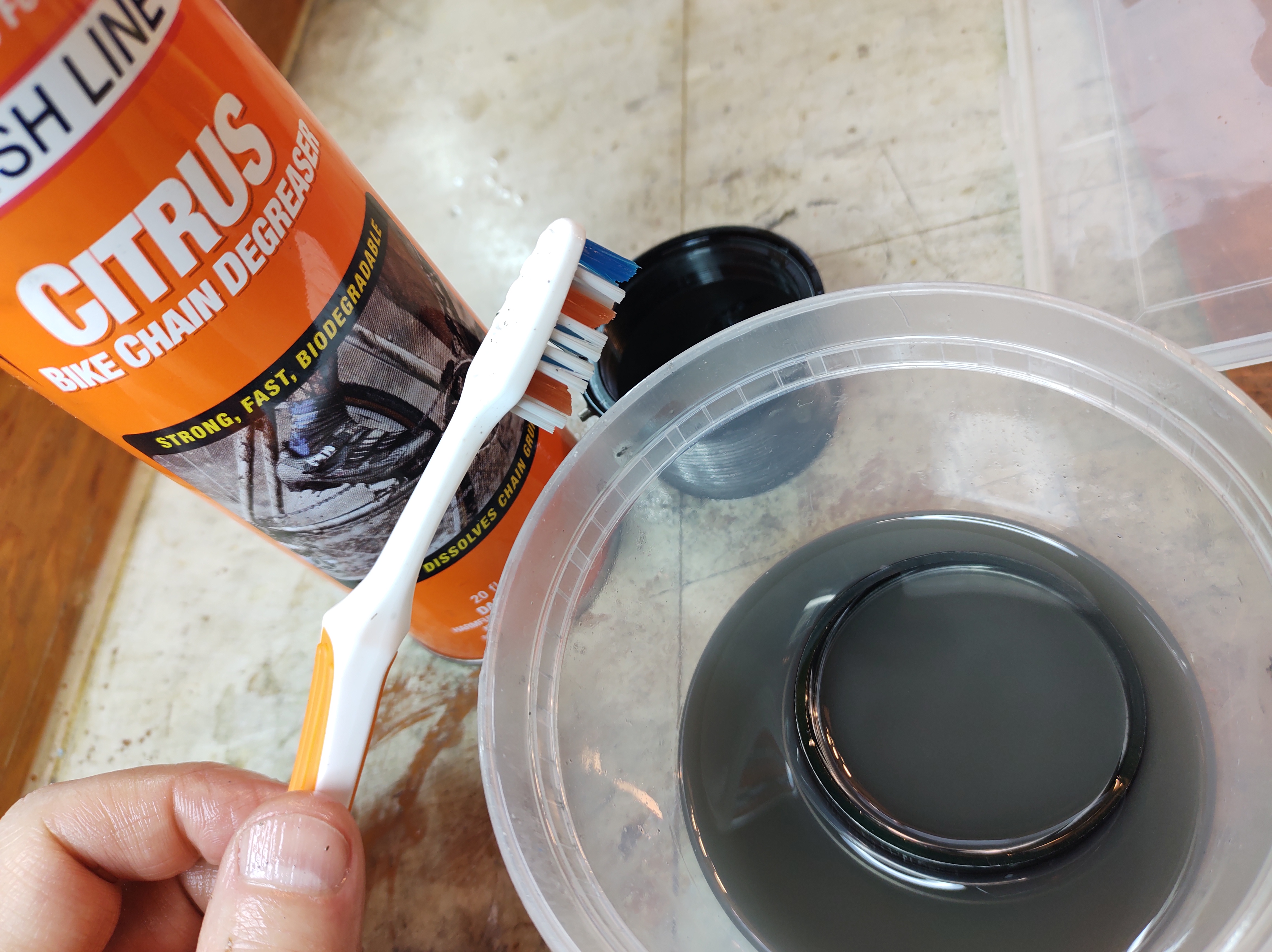
Finish Line is a favorite cleaner / degreaser made for bike chains. Made from orange peels. It's not dangerous to your health (unless you drink it), plus it smells really nice.


The focus collar had been manufactured with polishing marks in different directions. I masked with tape while I touched them up. First one direction, then the other.

The knurling had some kind of gunk in the grooves, of course. The "fixed" portion is on the left. "With vintage goo" is on the right.

A woven nylon polishing wheel. A little harsher than a cotton wheel, so it leaves a "brushed" finish. Hence, the carefulness regarding the direction of polishing.

The knurling on the right side still has the pitting and scratches yet to be taken out. The left half is cleaned up.

Cotton wheel for the faces that seem to have been intended to not have a grain to them.

Focus collar with vintage scratches visible at the bottom.


Care was taken to not obliterate the engraved markings.

Soaking again in the degreaser to remove the polishing compound.


This is a silicone grease I made by mixing silicone spray and pure silicone grease. It turned out to be a mistake. The spray was nice and thin to begin with, but after the solvent in it evaporated, it just left a very heavy grease. Too heavy for a camera lens. The right stuff turned out to be Marvel Mystery Oil (not pictured). Disassemble, degrease, and start over.


An observation on the design of old Russian lenses, compared to others. They're not very sophisticated. When you work the focus mechanism of this lens, the black ring on the left rotates against the silver barrel. It's an aluminum ring against the brass of the barrel. A Japanese lens would never allow this to happen. There would either be a bearing there, or it wouldn't be a friction point at all. In the case of this lens, it's just a film of grease keeping the two from grinding against each other. With some careful sandpaper and 3M pad work, I was able to smooth out the interface where the barrel and collar meet. There were a couple of places in this lens that I was surprised to find room for simple improvements like this.


A 2mm x 3mm screw. Don't drop it. But of course, I did. At least I had had the presence of mind to be working on a brightly colored towel, so the screw didn't bounce merrily across the bench and onto the floor, to be lost in the mists of time itself.

Reassembled, and about as good as I was capable of getting it. At least I managed to get the helicoid cleaned up. It's much lighter and whippy to use now.

It's an 85mm f/1.5, which lets in a huge amount of light. It's a very flattering portrait lens, and can be used easily in dim light. The aperture is wide open in this photo. Russian lenses are courteous enough to put the year in the serial number, almost always as the first two digits. So, this lens is a 1961 model. The logo at the bottom there is the mark of the KMZ plant, located just outside Moscow.


2/19/15

Revere Movie Cameras - Watching the kids.

Who doesn't like going to the beach to film children in bathing suits? Nobody, that's who doesn't! Revere wants to help you capture the moment on your next beach holiday.


Oh, wait. Those are his own kids. Well, that's okay too. Back in 1948, they didn't have to worry about anybody misinterpreting the photo in this ad. To be sure, our century did not invent pedophile sickos. They've always existed, but among the readership of The Saturday Evening Post, this notion was inconceivable.

So, thanks, 24-hour news cycle, for making sure that we think of perverts first and parents second!

Maybe you're still pure of heart and mind. Maybe you're having trouble seeing this ad in a sinister light. Well, that's what the Phil Are GO! Graphic Blandishment and Photoshoppery Squad is here for. Without putting too fine a point on it, we have managed to enhance this ad so that even the most puritanical zealot can view this ad the way we view it.


There, isn't that better? I mean... isn't that much much worse? Unless you're a monster, you'll now feel the need to have several showers. You're welcome!


12/23/10

United Film Club - Now it's cheap as free.

Once again. We're going to take a good, hard look at the state of amateur photography in the past., giving it a good expectant glare, waiting for it to explain itself. What with things being the way they are now, the film industry of 1968 will dig it's toe in the dirt and act all awkward, going "Well, I, uuh...". Check it out. The United Film Club.
Presumably, the club bought film in huge quantities and passed the savings onto their lucky members who, through the strength of their numbers, were able to take their snaps for a pittance, due to the cheap film stock. Look what passed for a "bargain" in 1968:

126-12 Kodacolor Instamatic cartridge film for $4.49. This should be a discount, due to the whole "buying in bulk" thing the club relied upon. Take $4.89 and drop it into our handy inflation calculator and it comes out to... duht dah daaaah...$29 in 2009 dollars! Holy shitballs! That's $2.48 per picture - assuming they all came out okay. Today I took my USB stick to Walgreen's and got some 4x6 prints for 29 cents each. That's like getting your twelve prints for sixty cents in 1968.

Never mind the fact that, with modern digital photography, you're choosing only the good shots, and of course you can see the results immediately and delete the bad shots without paying to have them developed. Back in Yore, you were hoping to get a couple of good shots out of your roll of twelve.

Ladies and gentlemen, we are spoilt. Let us rejoice and be glad in it. Also, even consumer-level cameras today do look a little better than the cheap plastic boxes we see here in this ad.

Here's a little bonus for Exmas. It's a high res version of the Santa from the ad (Click through for hugeness). The Image Improvement Team contrasted the background to pure white, so if you use it as clip art or something, you shouldn't see a dirty yellow square behind him. If you're some kind of fancy-pants graphics pro, you should be able to vectorize him through Adobe Streamline, LiveTrace, or whatever, without too much trouble. You're welcome.

Published with Blogger-droid v1.6.5

9/30/10

Multiplane Camera - 3D, the good way.

On January 25th, 1947, the English magazine Picture Post ran an article on Song of the South, Disney's most embarrassing release. It's a movie that Mickey and Co. would love to pretend never happened, due to it's racist content. You can't buy it or see it on YouTube.

That's as may be, but the article also features a pretty good photograph of Disney's (Meaning they owned one, but not that they invented it.) multiplane camera.

A multiplane camera is a massive apparatus designed to make very fancy cartoons, and to break the spirits of men. It is huge and complex, with several planes of animation painted on transparent layers, so that when the camera looks down through these layers, the camera's depth of focus creates the illusion of depth. Characters can be in focus, while other layers of the animation are out of focus.

You've seen the results of this type of camera if you've seen Cinderella, or Popeye Meets Sinbad the Sailor (1936),my personal multiplane favorite. Although not the exact same machine as a conventional multiplane camera, Max Fleischer's setback camera used miniature three dimensional sets and 2D animation cels to create a similar illusion.

 This kind of 3D works for me in a way that the Avatar kind doesn't. I don't like wearing the glasses. The illusion works some of the time, and when it doesn't, it just gives me a headache. I much more enjoy the illusion of watching a miniature world moving on a table top than the electronic illusion of being in a giant 3D world.

So who brought up miniatures? Well, exaggerated depth of field is what you get when you're shooting with a macro lens. Long story short, when the lens is focused on something very close, the background becomes very blurry, as well as anything that manages to squeeze between the lens and the subject matter. On your point-and-shoot camera, it's the little tulip icon, and it makes all your tiny stuff seem magical.
An interesting equivalent (because I like them for the same reason) is tilt-shift photography. Basically, this is the technique of using a special lens to make real-world scenes look like a tabletop miniature. A tilt-shift lens is really intended to take pictures of things without perspective distortions. But, if you use it wrong (right!), you can make big stuff look tiny. Hooray!


Or... you can fake it in a computer and get similar (really similar) results. There are lots of tutorials on the web that'll show how to do it yourself. The trick is choosing a photograph that is suited to the effect, like scenes shot from a distance and above, like you're looking down on a model. I recommend searching YouTube for some tilt shift videos.

If I wanted to read into my preference for tilt shift versus Avatar-type 3D, I may deduce that I insist on feeling huge, rather than feeling like I'm in a giant world. I say I just like train sets, and I don't like having headaches.

2/5/10

Anscoflex Camera - Hideously Beautiful

My dad was an engineer. No, not the kind that wore a funny hat and drove a train. He designed machines. He never designed a camera, but if he did, I think it'd look a lot like this Anscoflex.

Anything dad built, he overbuilt. Knobs had to be big... big enough to operate with mittens on, maybe even while wearing a pair of catcher's mitts. If it was made of aluminum, it could be left bare. If it was made of steel, it'd be painted this same shade of Institutional Grey-Green (I.G.G.) that you see in the picture. Everything must be screwed together, so you could take it apart if you had to. The screw heads were left exposed, and as such, all had to match. You could never have mix-and-match screws in my dad's school of design. It must also be able to tolerate a three story drop without major malfunction.

Durability and repairability were the watchwords of my dad's design ethic. Elegance and minimalism were not. There was no Apple-esque, breathtaking, fragile other-worldliness to my dad's machines. he saved that for his woodwork. In the parlance of Tolkien, his designs were more dwarven than elvish.

This is not a criticism. It's just a fact. This is why I think this Anscoflex is both hilariously ugly and great at the same time. It's an almost perfectly un-stowable squaretangle. It fits in no pocket. Any bag used to carry it can carry nothing else unless the bag is really huge. It has that leather strap that, if you look at the little illustration in the lower left, might be long enough to go around your neck. Fine. So you were to carry this thing around your neck, having it's three-pound bulk thumping you in the sternum while you walked around Santa's Village, spilling food on it while you try and eat. This is what they call a "box camera". It's meant to be worn around the neck, so you could look down into the viewfinder to line up the shot. See the gray door on top?
It's not a missile silo. That's the viewfinder in there.

It looks like it was designed for the person who is normally intimidated by overly-fiddly cameras. THere aren't many controls. There's a giant knob to advance the film and a button to take the picture... and the button is bright red. No focus or exposure. I like the textured metal face behind the lens garage door thingy. It could be flat aluminum, but instead it's textured, like metal burlap or something. Style!

Come to think of it, most of the hardware on Thunderbirds looks like this. Clunky and lumpy. You can tell what parts are meant to twist and what parts are meant to be pressed. There's no sneaky disguising a button as a piece of decorative trim, like on my Logitech Harmony universal remote. You can operate it without looking, because no operable part is flush mounted or smoothed into the surrounding surface. Things like that are designed to be looked at, but not used. So, my mixed review of this camera would probably be that it's a joy to use and manipulate, but a huge pain to carry around.

UPDATED: Here's a funny thing - looks like if I were a bigger jerk, I could try to sell this ad on Ebay for ten dollars. I bought the whole magazine for four at an antique store.

11/12/09

Polaroid - Choose? No thanks.

Earlier this fall (10/2009), after previously announcing it would be halting production of it's instant cameras and film, Polaroid announced it would once again be in the insta-photo business. This was mostly because loads of people went "Nooooooo!" Then Polaroid went "Really?" Apparently, there are still lots of people who need a picture of something really quick, even if it looks like crap. Crime scene investigators and construction guys were the two that stood out most in my mind. Polaroid pictures look like hell, and so do the cameras. The pictures don't have much of an excuse. The technology's as good as it can get. The cameras don't have an excuse. They're designed. By people. Who have eyes. I think.
Polaroid says "Choose". My answer is "Do I have to?" I guess they're proud of the completeness of their product line, from cheap and ugly to sort of expensive and frikkin hideous.

When I first turned the page on this ad, just because of the way the cameras are arranged, I thought it was a series of teardowns. You know, where they show you the inside of a device by taking off some bits and snapping pictures. That was about a half a second of my looking-time. Then it became horribly clear that these weren't pictures of a camera in progressive states of disassembly. These were a row of five complete cameras in saleable condition! I flinched.
Polaroids have never been attractive cameras. However, at least they looked "finished". They looked like they were done being assembled. This line of Polaroids look like a normal camera with the shell taken off. Each looks like it was  made out of pieces of five or six different cameras of better breeding.

It takes a real force of will to make boxes and rectangles clash with each other. Polaroid's designers found a way! Any shape you find on one of these monstrosities will not be repeated anywhere else on the thing. Make a notch on one side and don't balance it with a feature of similar shape on the other side. Add a box on the top and be sure not to use a texture from anywhere else on the camera to tie it in. There are brushed metal surfaces, painted silver surfaces, textured black plastic, smooth black plastic, ridges and unnecessary lines everywhere.

Many things from 1968 were beautiful. I can't believe Polaroid found a camera mighty enough to take a picture of their cameras without cracking the lens.

10/21/09

Kodak - Rejoice, We Are Spoilt

Christmas, 1961. A camera under the tree. "Weeeeee!" goes little Rufus. "Weeeeee!" goes little Agda. "Weeeeee! Why'd we give our kids weird names?" goes mom. "It was your idea. This marriage is a lie! Weeeeee!" goes dad.
Not to put too fine a point on it, your mobile phone can do 90% of what this family wanted this camera to do for them. Your pocket-sized point & shoot can do 90% of what all the stuff on the right could do. Maybe 92%. This is definitely great. All this capability owes it's existence to these guys, who just won the Nobel Prize for inventing the CCD chip that has made basically every non-filmy camera technology possible.
Look how cool all those cameras are. All boxy and chunky. In some way or another, each resembles the front of a semi truck. Hilarious and great. So, in a way, it's kind of sad that the era of this stuff is now gone. You can find really good film cameras in antique stores for not much money at all, maybe 15-50 dollars, even for a European brand. They are tempting, but I'd only be buying it to worship the engineering. As always, all of these images can be clicked and viewed at insanely high resolution.

Lastly, look at the plug for Disney's TV show "The Wonderful World of Color". BAH hah hah! That's adorable. Color was still enough of a thrilling novelty that they put it in the name of the show.


Jeez. Now that I'm thinking about it, maybe I'll have to get an old film camera. You know.. just to worship the engineering of it.