Showing posts with label video games. Show all posts

9/4/15

Joust sculpture - Art with a sabre saw.

I made a art! I made it in my car hole. See how it happened and ask yourself "Why did he make art in his car hole?".


It's for an exhibition with the theme "Retro Arcade". I fed my share of quarters to the machines in Aladdin's Castle when I was a kid. My brother and I liked to play Joust. Like all games of that era, it was designed to be fun and brutal. They wanted all your quarters as soon as possible. So, I won't say I was any good, but my bro and I had a blast stabbing birds with our lances.

Here's some gameplay footage, in case you aren't familiar with the game, or had sex in high school...


It took a good second and a half to decide what to do for the exhibition. Just take the blue and white player ostrich, and separate his colors into layers. Then, cut the layers out of plywood and stack them up. It would just be a big wooden joust bird. Simple, right?

Simple-ish, but loads of cutting and sanding and priming and re-sanding and painting and assembly and touch ups. Anyway, it got done, and it's 28x28 inches. After the exhibition comes down, I need to figure a place to hang it. I may also need to reinforce my house so the art doesn't collapse the place. It weighs like thirty pounds.

To the left, you can see Step One. Figure out the layer order. Each layer had to cover the same or greater number of "pixels" as the one below it, so there'd be no weird voids in the sides.

After that, it was a matter of getting access to a large-format printer to have an outline of each layer printed out, to use as patterns.


The whole way through, the biggest challenge was keeping track of which chunk of wood goes to which layer, to make sure everything got painted the proper color.


Initially, I thought I'd cut out the patterns, and trace around them, but the curliness and floppiness of the paper made it really hard to make sure the drawing on the wood came out in the right shape.


Then I wised up. The smart move was leaving the paper intact, and just tapping a nail through at each corner where lines met. Then, I just removed the paper and connected the lines between the little nail marks. Victory.


The whole way through, the biggest challenge was keeping track of which chunk of wood goes to which layer, to make sure everything got painted the proper color.

The wood rasp in the above picture is the one I used to accidentally cut a vee in the end of my thumb, fingernail and all. That was enough work for one day. No ghoulish bloody thumb notch pictures for you.


Even a cheapo Chinese set of forstner bits are a smart investment. You can drill holes with perfectly clean edges. No splintery mess around your hole. The holes are just large enough in diameter to allow the sabre saw blade to turn at the corners.


The remainder wood was left in interesting shapes, such that I still can't figure if I should throw it away or not.


The plywood looked so nice bare, it was tempting to leave it unpainted. But, color would be necessary.


Instead of building the layers from the bottom up, which would be more intuitive, they had to be assembled from the top down, to allow access to the back of each layer, so the screw heads would be concealed.


After this photo was taken, I still had to do some straightening of some blocks. This usually involved just grabbing them really tightly and twisting, hoping they still had some play. No glue was used, so technically, I could take the whole thing apart if I needed to. However, the paint was still kind of soft at the time of assembly, so it acted like an adhesive.

Art complete!

1/25/12

Video Pro Glove - It must be gone for!

Video Games magazine, 1983. Gamers receive a glimmer of hope for their sore, blistered palms: the Video Pro Glove.
Designed by mother and video game outsider Carmel Delaney, it was meant to protect the tender palms of 1983's game addicts. Clearly, the obvious need for such a product is demonstrated by the widespread use of gaming gloves we can observe here in The Future. Wait a second. I've just been informed that nobody wears gloves to play video games. Oh well. People aren't always ready for The Next Great Idea.

This is not to say that people have stopped trying to sell us video gaming gloves. Far from it. However, Delaney was so far ahead of her time that those whose time she was also ahead of are still ahead of their time. That's a lot of time-aheadness. She was a visionary.
Video Pro's primary off-label application: beating up Daniel-San.
 A year after the Video Pro Glove was released to a baffled public, the gloves found a home on the hands of Johnny Lawrence, noted Prell user and super-mean leader of the Cobra Kai gang. Their motto was "No mercy... except perhaps for your blistered hands! But definitely no mercy for split ends!"

The metal edges underneath a standard banquet table are rarely de-burred.


After losing to Daniel Laruso in the All Valley Karate Tournament, Johnny became Greg Tolan and took up competitive food spilling (ESPN 3, most Wednesdays at 2:30 am.), eventually locking horns with Rick Morehouse in the cafeteria. Again, he looked to the Video Pro Glove for protection during Critical Bullying and Narrative Exposition Events (CBNEEs).

So really, just like the iPhone, duct tape, and electric scalp massagers, the Video Pro found a role in society beyond the original intended purpose. This is the sign of true genius. Carmel Delaney is one such genius. Maybe there's a little Carmel Delaney in all of us? Don't you think? No. Definitely not. ...Or is there?... No.


11/23/10

Synapse C64 Games - The beginning of greatness.

My gaming life began on those horrible Pong systems. You bought a console with a pair of paddle controllers, hooked it to your TV, and you could play Pong or one of it's variants, like "vertical pong" or "small paddles pong". This was still heart-stoppingly exciting, but now it's embarrassing to admit. Somehow a rectangle was more interesting than Johnny Carson if you could make it move.

The jump from "symbols" to - I'm going to drop a line of demarcation here - "actual graphics" was brain-explodingly amazing. After seeing little people on your friend's TV screen instead of squares made it hard to ever go back to your suddenly lame Atari 2600 version of Combat at your own house and pretend to be satisfied. This ad for Synapse games shows what I mean.

Yes, by the time the C64 appeared, the Atari 2600 was running much better software, thanks to Activision. But once one saw what the Commodore could do, you began to wish your dad was a stock broker douchebag so you could get one. Nothing else was close.

Pharaoh's Curse looks like a pretty standard platform game, but when you consider that this was 1983, the idea of a large scrolling environment to explore was pretty exciting. Pitfall II was a similar title available on the Atari, and I found the game so compelling, I drew a map of the entire game on graph paper and plotted out my path. The map was about three by four feet, with every enemy and pickup drawn in ridiculous detail. I felt like Columbus, charting a new world. The fact that it is immediately recognizable as a game whose basic functionality is still repeated more than twenty years later is pretty high praise.

Fort Apocalypse looks pretty damn good too, for 1983. It looks similar to Choplifter, which featured a lovingly animated helicopter that tilted perfectly as you swooped around rescuing little soldiers. This was a far cry from what had gone before, which was a square or worse yet, a flickery jumble of squares that game designers sheepishly hoped you would accept as a helicopter.

Protector II looks to be a pretty shameless copy of Defender, right down to the name. Plagiarism was rampant among PC game companies back then. I don't think copyright laws had caught up with the gaming industry just yet.

This generation of games reflects a certain point of maturity in the games industry. Games now needed to be produced by, at minimum, a two-person team, instead of just one programmer with no real art skills. A programmer needed to either be a part time artist or have an artist buddy help him out with his game. This looks like the beginning of specialization in gaming that still continues to this day. If you want a job at a game company now, "game artist" is a title that hardly exists. You are a concept artist, 2D animator, motion graphics artist, interface designer, 3D modeler, rigger, texture artist, or environment designer, etc. Often, companies will interview artists for a very specific role, not just "artist" I think the generation of games shown in this ad captures the point at which game companies had just begun to hire artists.

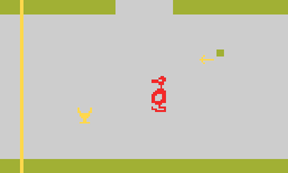
By contrast, look at Adventure, an Atari game from 1979. It was a groundbreaking game and featured many "firsts". First adventure game on a home console. First game to allow a player to manage an item inventory. First multi-screen adventure game. First hidden message or "easter egg" in a game. The easter egg was this: "created by Warren Robinette". He was a programmer that made the game singlehandedly, though he wasn't an artist. The genius of the gameplay is famous, but the art is still pretty funny. At the time, it was fine, because as an early Atari game, the console didn't have the horsepower to display any real art. By the time the C64 came to be, the computers were ready for artists.


11/1/10

Vic-20 - Believe your eyes.

Poor, poor computers. Due to the basic reality of Moore's law, the laughability of old computers progresses in direct proportion to the power of new ones. As much of a superstar the newest, powerfulest machine is right now, it'll be the butt of jokes in, say, twenty years or so, when someone comes across advertisements proclaiming it's power.

Those CAN'T be actual Vic-20 screens, you lying bastard! The graphics are hyper-real! Actually, they're not too bad for 1983, considering that your TV's remote probably has more computing power than a Vic-20.

Click the image to enlarge, and anyone over the age of twenty should be able to name the games being ripped off here. From left to right, they look like Galaga, Defender, Something with squares in it, and Donkey Kong Junior.

The airbrushed eyeballs at the top are pretty terrible. Remember how everyone in the eighties was convinced that airbrush was the ultimate medium? Here's an example of a bright-eyed young artist trying his hand at sprayed art. Ug. Shading human skin requires a lot of different colors delicately balanced. Lots of finesse. This guy painted some salmon orange color and shaded with brown. See the highlight on the right side of the nose there? Never spray white directly onto your base tone. You need to go through a yellowish color before you get to white or the white will look chalky and blue. Ah well, video games were a small industry back then, and Sierra probably didn't pay much.

Sierra On-Line is remembered with a moist eye by many computer game old-timers. They were a husband and wife team who made some of the greatest graphical adventure games like King's Quest. They took the classic text-based adventure game format (like Zork) and added graphics. Since text-based games made your imagination work to create the pictures, adding graphics to stories of similar quality was a big leap in immersion. Compared to pure text, graphics of any kind were mind-blowing. Sierra never leaned too heavily on graphics. They (almost) always emphasized compelling story telling.

So what's with these arcade game knock-offs? I think the popularity of games like Donkey Kong and Defender -  and the sweet sweet cash they earned -  were too tempting to ignore.